Tree Removal in Clarksville, TN
Single trees, hazard timber and whole tree lines taken down on rural and suburban ground, priced by diameter, lean and what is standing underneath.
Get a Free Land Clearing Quote in Clarksville
Tell us the acreage, the road it fronts and what the ground has to do afterwards. Form requests are answered the same working day, and every quote follows a site walk.
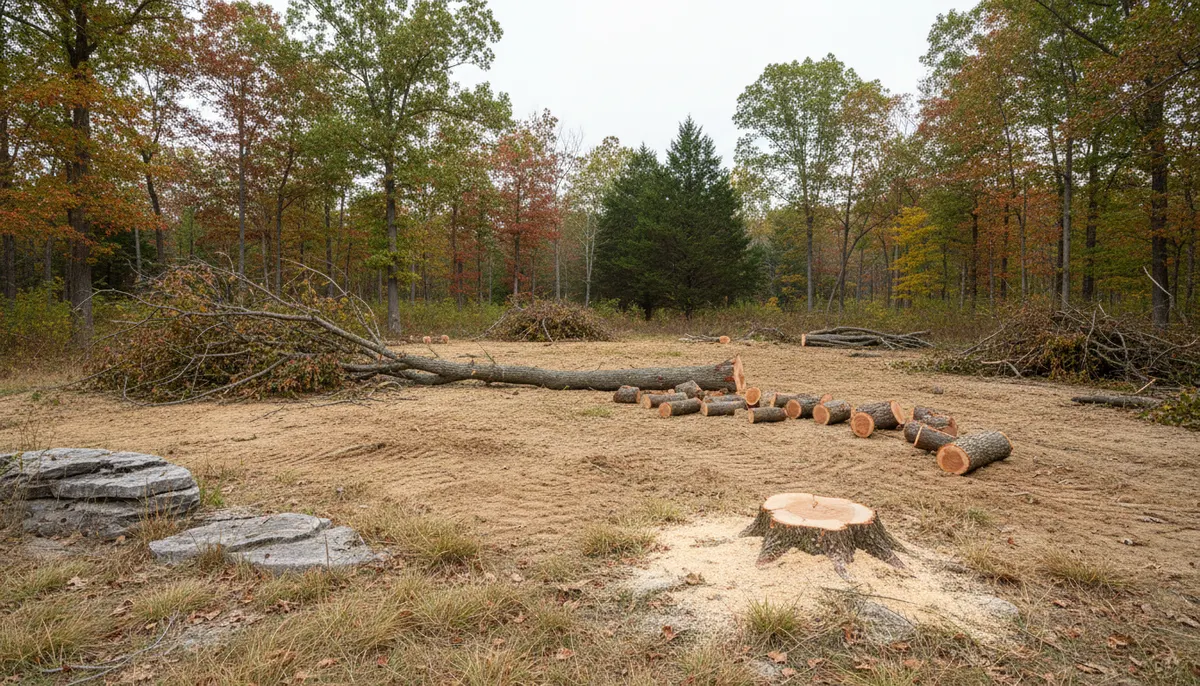
Tree removal in Clarksville, TN is priced less by the tree than by what sits under it. The same forty-inch white oak is a straightforward drop in an open field and a rigging job over a roof.
Oak and hickory make up close to seventy percent of Tennessee forest land by forest type group, and eighty-three percent of it is privately owned. What is standing on your parcel is likely white oak, red oak, chestnut oak, hickory, yellow-poplar, red maple, sweetgum, ash, elm or hackberry, and each behaves differently on the way down.
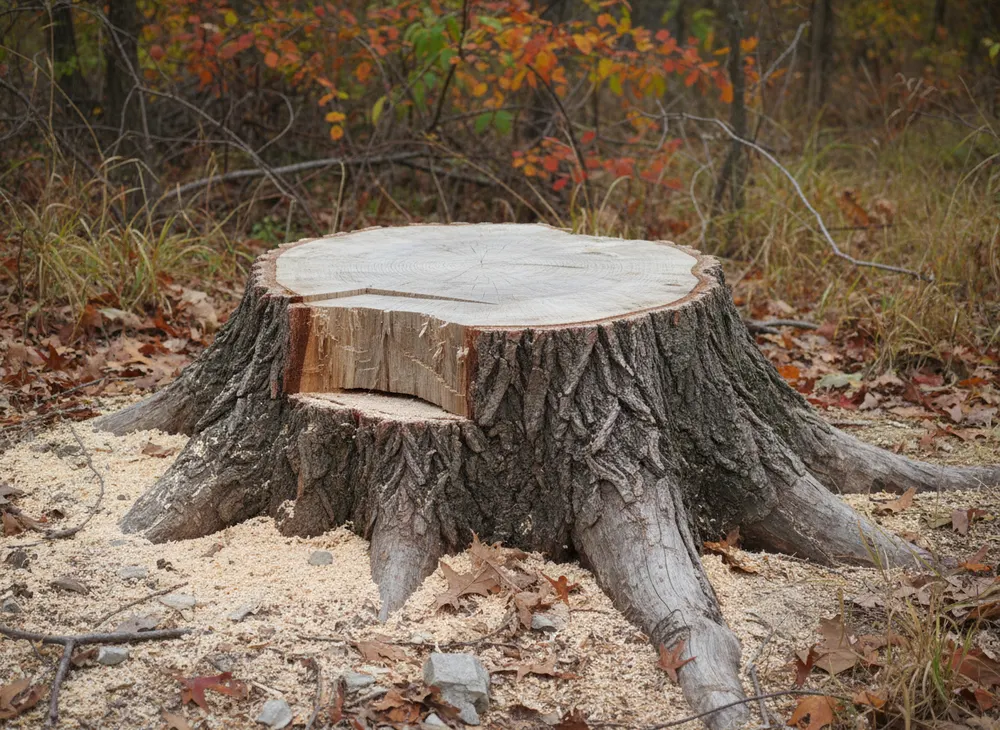
Removals We Take On
Hazard Trees Over Structures
A leaning stem, split fork or lifted root plate near a house, barn or power line, rigged down in sections rather than felled. Prices vary threefold at the same diameter.
Open-Ground Felling
Trees with a clear drop zone on acreage or pasture, the cheapest removal there is.
Tree Lines and Volunteer Growth
Rows along a boundary or field edge, usually red maple, sweetgum and hackberry, priced as a corridor once the count gets high.
Storm-Damaged and Hung-Up Timber
Trees already down, partly down, or with limbs loaded in the canopy, where the loaded material is the danger.
Species on Montgomery County Ground
The oaks and hickory
White oak accounts for 9.2 percent of Tennessee timber volume and chestnut oak 8.2 percent, both dense wood that rigs predictably and holds a hinge. Hickory has more spring in the limbs.
Yellow-poplar, the volume tree
Yellow-poplar is the largest single species by volume in Tennessee at 11.6 percent, and 6.9 percent of stems. It grows tall and straight with the crown high, so a removal is about height and reach rather than spread, and the light wood changes the rigging and haul volume.
Red maple and sweetgum, the count trees
Red maple is the most numerous species in Tennessee by stem count at 9.6 percent, with sweetgum at 5.6 percent. Neither carries much volume individually, which is why they show up as tree-line work rather than single removals.
How a Removal Runs
-
Walk the tree and the drop zone
We measure diameter at breast height, look at lean, decay, dead wood in the crown and the root plate, and decide whether the tree is felled or sectioned.
-
Locates where ground gets disturbed
Felling alone needs no utility locate. Stump grinding, root removal and machine access that breaks ground does, and Tennessee 811 requires three working days of notice.
-
Take down
Straight fell where the drop zone allows, sectioned and lowered where it does not.
-
Wood, brush and stump
Brush is chipped or hauled, usable wood cut to length and left if you want it, the stump ground separately if in scope.
Reading a Tree Before the First Cut
Diameter is the unit, the crown is the multiplier
The measure this trade quotes against is diameter at breast height, taken roughly four and a half feet up the stem. It predicts weight, and weight decides whether a tree is felled in one piece or comes down in sections on ropes.A yellow-poplar and a white oak of identical diameter present different problems: the poplar carries its crown high and narrow, the oak wide and low. A price quoted from diameter alone is a guess. Decay changes it again: a hollow stem may stand for years but will not hold a hinge. Where limestone sits close to the surface, which it does across much of this county, roots follow solution channels rather than spreading evenly, so the root plate can be smaller and more one-sided than the crown suggests.
The regulatory position, stated accurately
Customers ask whether they need permission to take down a tree on their own land. The City of Clarksville Forestry Division maintains trees on city-owned properties only. Clarksville has held Tree City USA certification for thirty-four years and the Tree City USA Growth Award for eighteen. In unincorporated Montgomery County the zoning chapter dealing with vegetation is titled Landscape, Buffering and Screening Requirements and defines critical root zone and drip line, standards attached to development approval rather than a standalone tree ordinance. What gates clearing work here is stormwater: soil disturbance above one acre pulls in county land disturbance requirements and state stormwater coverage regardless of stem count. For a parcel inside city limits, call the city forestry division first.
Tree Removal Prices Around Clarksville
$400 to $1,200 per tree, with stump grinding at $2 to $6 per inch of diameter
Published 2026 cost-guide figures, given as ranges because price is set by access and rigging rather than species.
| Scope | Typical range | What it covers |
|---|---|---|
| Single tree removal | $400 to $1,200 per tree | The spread is drop zone and rigging, not diameter. |
| Stump grinding, per inch | $2 to $6 per inch of stump diameter | Measured across the stump at ground level, not breast height. |
| Stump minimum and additional stumps | $80 to $160 minimum, then $30 to $60 each additional | One isolated stump prices at the minimum. |
| Full stump extraction | $100 to $400 per stump | Pulling the root ball rather than grinding, as a build pad needs. |
| Debris handling | Chipping $100 to $150 per hour, hauling $150 to $200 per pickup load | A pickup load is 2 to 4 cubic yards of brush. |
What moves the price
- Drop zone. A clear fell and a sectioned removal are different jobs.
- Proximity to a structure, fence, septic field or overhead line.
- Access for chipper, truck and grinder.
- Crown spread and decay, which change the method.
- Whether the stump stays, is ground, or is pulled.
- Number of trees on one mobilisation, since set-up is charged once.
Three trees on a suburban lot: a 30-inch white oak sectioned over a driveway, two red maples with a clear drop. The oak sits at the top of the removal band and the maples at the bottom, so felling is roughly $2,000 to $2,600. Grinding the oak stump at $2 to $6 per inch is $60 to $180, but the $80 to $160 minimum applies, and the two maple stumps add $30 to $60 each. Two hours of chipping at $100 to $150 per hour clears the brush.
Working with Us on a Removal
The method is named on the quote
Fell or section, chip or haul, grind or extract. Put it beside another quote and compare.
No answers on regulation we have not checked
Where a permit question is unresolved, we say so and find out.
Removals bundled to save money
Set-up and travel are charged once, so one mobilisation beats three visits.
Tree Removal Questions
What is diameter at breast height?
The standard forestry measurement, taken about four and a half feet above ground on the uphill side of the stem. It is a proxy for weight, which decides whether the tree is felled whole or comes down in rigged sections.
Do I need a permit to remove a tree on my own property here?
We will not give a yes or no we have not verified for your parcel. City forestry maintains city-owned trees only, and the county handles vegetation through landscaping standards attached to development.
Is grinding enough, or does the root ball come out?
Grinding takes the stump below grade and leaves the roots in the soil, fine under lawn, mulch or pasture. Where a footing, slab, driveway base or septic field is going, the root mat has to be removed rather than ground, a grubbing scope in a higher band.
Can I burn the brush instead of hauling it?
Sometimes. Tennessee requires a Division of Forestry burn permit for debris pile fires from 15 October through 15 May, valid for the day of the burn only, with a firebreak of three feet through leaves and five feet through tall grass or brush. State air rules allow branches, limbs, twigs and clean untreated wood, cap a burn at forty-eight hours and no more than twice in thirty days, require written consent from occupied buildings within a hundred feet, and prohibit burning most vegetation not grown on site.
Do you leave the wood, or take it?
Either. Usable wood cut to firewood lengths and stacked costs less than hauling it away. If it goes, it goes as chip or loads, priced by the hour or the load.
After the Tree Is Down
Taking the stump below grade is a separate visit and price unless booked with the removal.
Thinning an understory, keeping the canopy is what most wooded-lot owners actually want, and costs less.
Getting brush and wood off the property becomes the larger half of the bill past a few trees.
Timber a storm has already put down is different work: hangers carry risk a standing tree does not.
Book a Site Walk on Your Acreage
Send the parcel details and we will walk the ground, measure the disturbed area, check the stormwater threshold and put a written scope in front of you before any machine is booked.