Land Clearing Debris Removal in Clarksville, TN
Three routes for clearing debris, mulch in place, chip on site or haul it out, and the state rules that decide which is available.
Get a Free Land Clearing Quote in Clarksville
Tell us the acreage, the road it fronts and what the ground has to do afterwards. Form requests are answered the same working day, and every quote follows a site walk.
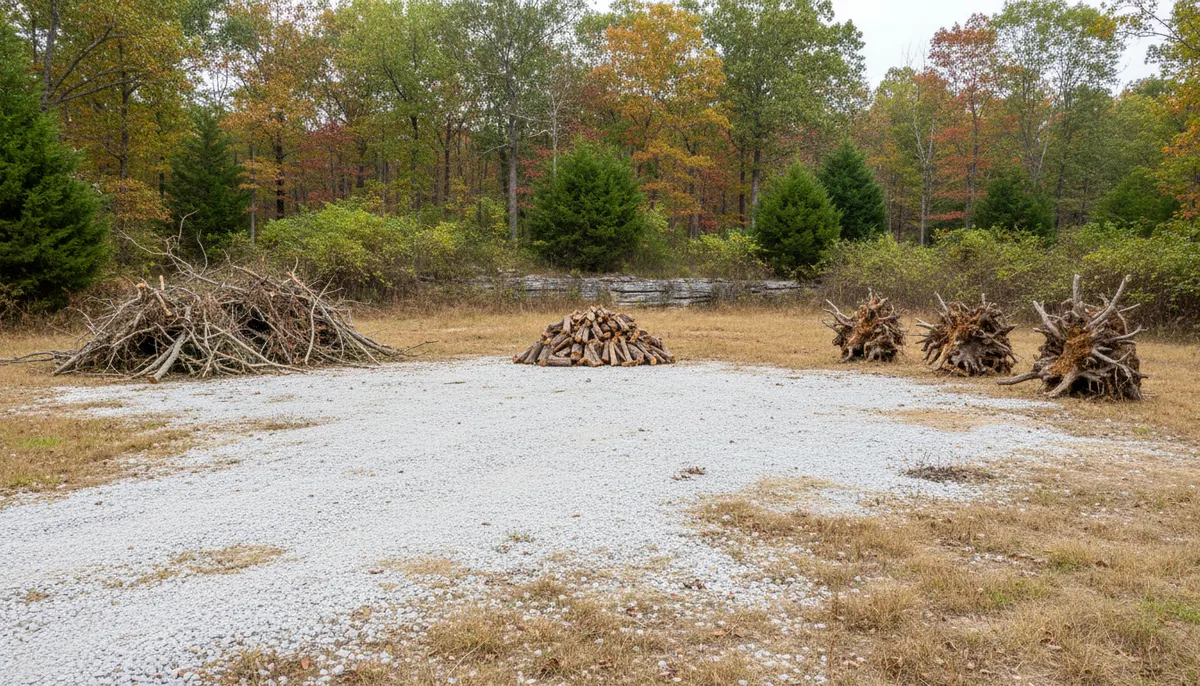
Land clearing debris removal in Clarksville, TN is usually the larger half of a clearing bill, and the half most quotes leave vague. Trees come down in hours. The material they leave takes days to move, and there are three honest ways to deal with it. Burning is a fourth, available far less often than people assume.
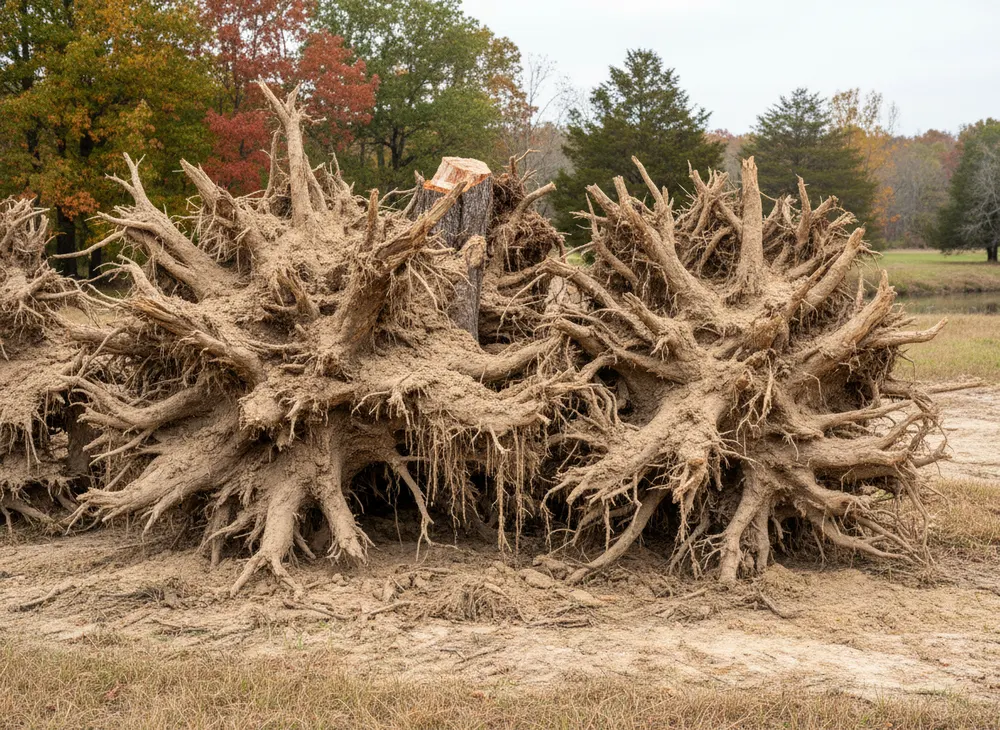
The Four Routes, Priced Against Each Other
Mulch in place
A mulching head grinds material where it stands and leaves it as a layer. No disposal line, and it holds soil on a slope.
Chip on site
A chipper reduces brush to a usable product by the hour. No permit season, no haul distance.
Load and haul
By the pickup load, the yard waste load, or into a dumpster. The only route when material cannot legally be burned.
Pile and burn
Cheapest per hour and most constrained. A permit season, duration caps and a consent radius all apply before a match does.
What the Pile Is Actually Made Of
Brush and slash
Limbs, tops and small stems. High volume, low weight, and what chipping was built for.
Stem wood
Trunk lengths. Low volume, high weight, often worth cutting to firewood length.
Stumps and root balls
The heaviest material on site, since soil comes with them. They chip badly, and grinding them in place is usually cheaper.
How the Material Gets Handled
-
Separate at the source
Brush, stem wood and stumps into separate piles as they are cut. Mixing them makes disposal expensive.
-
Pick the route per material
Brush chipped, stem wood left or hauled, stumps on their own.
-
Stage where a truck can reach
Piles built near a hard surface, because carrying is hourly work.
-
Clear and stabilise
Ground raked back, bare soil covered inside the stabilisation window.
The Burn Rules That Decide the Whole Question
A seasonal permit, good for a single day
From 15 October through 15 May a Tennessee Division of Forestry permit is required for debris pile fires and prescribed fires, and state permits are not required during the summer months. The permit is valid one day only and must be obtained on the day of the burn. It carries a firebreak requirement of at least three feet wide through leaves or short grass, and at least five feet wide through tall grass or brush, and on wooded land neighbours are notified two days in advance. Tennessee Air Pollution Control Regulations 1200-03-04 then cap a burn at 48 hours and at no more than twice in any 30 days, require constant supervision, and require written consent from occupied buildings within 100 feet. Leaves, branches, limbs, twigs, woody vegetation and clean unpainted, uncoated wood may be burned. Construction debris, treated or coated wood, asphalt shingles, plastics, cardboard and household trash may not, and neither may most vegetation not grown on the site. Violations can carry fines up to $25,000. That last clause decides real jobs, because material trucked in from a second parcel cannot legally go on the fire.
Mulching does not remove a permit requirement
A claim circulates locally that forestry mulching eliminates permit requirements. It does not. Mulching removes the disposal line item, which is a genuine saving, but coverage under the Tennessee Construction General Permit turns on the area of disturbance, one or more acres, not on the method used to disturb it. County stormwater obligations work the same way. Mulching changes your debris bill, not your permit file.
Debris Disposal Prices in This Market
$100 to $150 per hour to chip on site, or $150 to $200 per full pickup load hauled
Published 2026 cost-guide ranges. Volume is measured on site before a number is given.
| Scope | Typical range | What it covers |
|---|---|---|
| On-site chipping | $100 to $150 per hour | Leaves a usable product, no permit season. |
| Brush hauling | $150 to $200 per pickup load | One full-size load is roughly 2 to 4 cubic yards. |
| Yard waste loads | $150 to $350 per load | Widens with distance to a receiving site. |
| 20-yard dumpster | $275 to $700 | Usually cheaper than repeat pickup runs. |
| Hand labour and burning | Cleanup $50 to $80, burning $20 to $200 per hour | The cheapest rate and the least often legal. |
What moves the price
- Volume in cubic yards, the real unit behind a load price.
- How far material is carried to reach a truck.
- Whether the material was separated as it was cut.
- Whether the calendar allows burning on that parcel at all.
- Whether the material grew on the site it is sitting on.
A worked example. An acre of medium brush cleared conventionally leaves roughly a dozen pickup loads. Hauling at $150 to $200 per load is $1,800 to $2,400. Six hours of chipping at $100 to $150 per hour is $600 to $900.
How We Handle the Disposal Line
The route is on the quote
Chip, haul or mulch, with the unit named, so you can compare quotes.
No burn promised out of season
If the date sits inside the permit window, or the parcel fails the 100-foot consent test, we say so.
Separation happens as we cut
Sorting a mixed pile afterwards is hourly work you should not pay for.
Debris Removal Questions
Is it cheaper to chip or to haul?
Chipping wins once the pile passes a few loads, because hauling is priced per load while chipping is priced per hour and cuts volume at the same time. Hauling wins on small jobs and where there is nowhere to put the chip.
Can I burn debris a contractor brought from another property?
No. State air rules prohibit burning most vegetation not grown on the site, so material trucked in from a second parcel cannot legally go on your fire even if the rest of the burn is compliant.
What can never go on a burn pile?
Building material and construction debris, treated or coated wood, asphalt shingles, tyres, vinyl siding, plastics, paper and cardboard, coated wire, paints and chemicals, and household trash. Penalties run up to $25,000.
Does mulching mean I skip the permits?
No. Permit coverage is triggered by the acreage of soil disturbed, not by the machine used. A mulched acre is still a disturbed acre for the state construction stormwater permit and for county requirements.
Can I keep the wood chip?
Yes, and most people should. Chip spread thin holds soil on a bare slope through a wet spring and suppresses regrowth on a trail. Keep it thin if you plan to seed, since a deep layer ties up nitrogen while it breaks down.
Where the Debris Question Comes From
Piles a wind event left behind are the commonest reason people go looking for disposal pricing.
Cutting the standing brush in the first place is the job that generates the volume, so quote the two together.
Covering bare soil once the pile is gone is required rather than optional above an acre.
Book a Site Walk on Your Acreage
Send the parcel details and we will walk the ground, measure the disturbed area, check the stormwater threshold and put a written scope in front of you before any machine is booked.