Clearing and Grubbing in Clarksville, TN
Vegetation, stumps and the root mat taken out to competent subgrade, with the exposed-soil obligations that follow written into the same programme.
Get a Free Land Clearing Quote in Clarksville
Tell us the acreage, the road it fronts and what the ground has to do afterwards. Form requests are answered the same working day, and every quote follows a site walk.
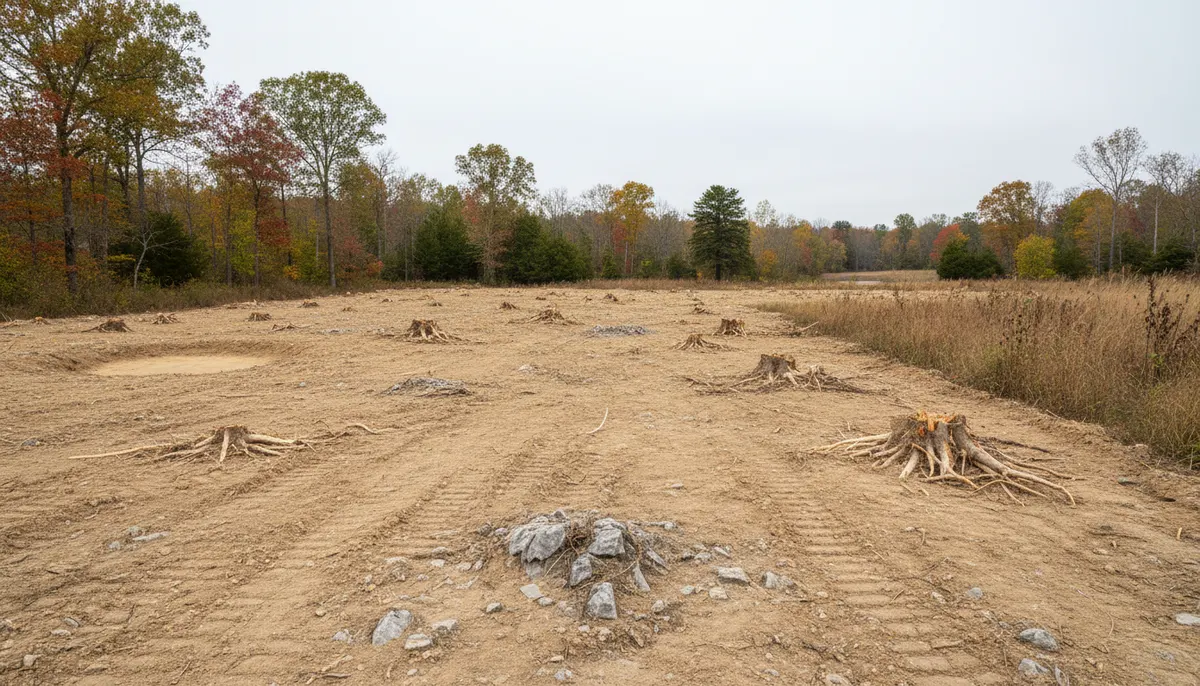
Clearing and grubbing in Clarksville, TN removes what is under the ground as well as what is on it. Clearing takes the stems. Grubbing takes the stumps, the root balls and the mat of fine roots and organic soil they sit in, down to material a footing can bear on. The Tennessee Board for Licensing Contractors uses the phrase directly: classification HC-5 reads Clearing, Grubbing, Snagging and Rip Rap, and it applies once total project cost reaches $25,000.
The distinction matters because the alternative looks cheaper on a quote. A machine can grind everything standing into cover in one pass, and that method leaves every root system in the ground. Fine where a fence line or a view is the objective. Not fine under a slab, a pavement section or a septic field, where organics decay, lose volume and take the surface down with them.
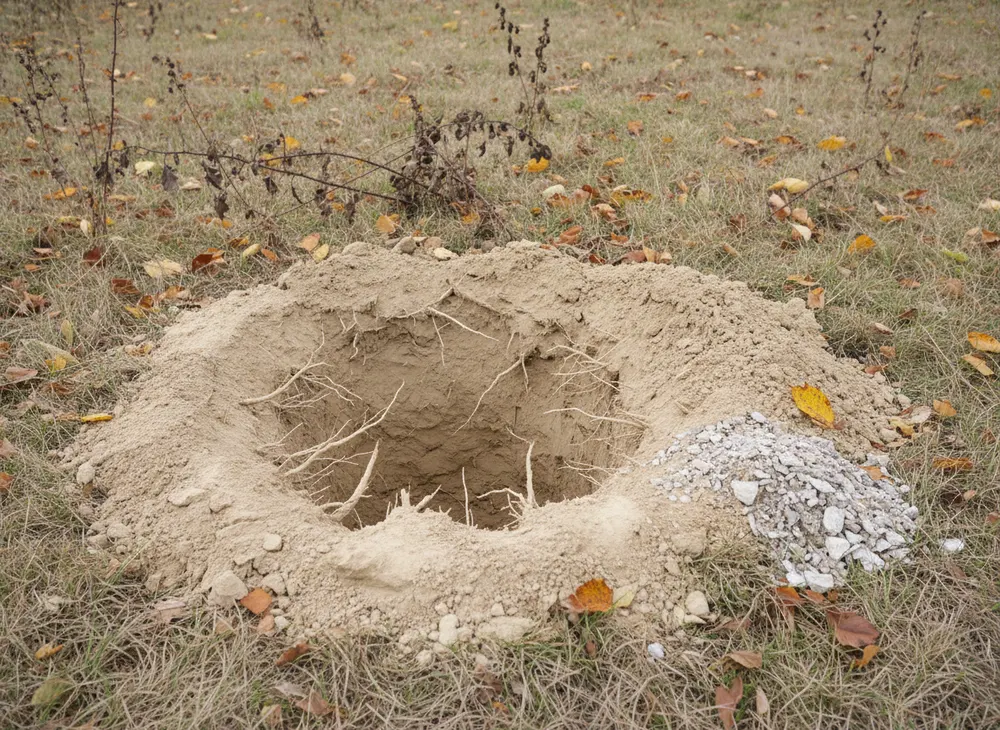
Where Roots Actually Have to Come Out
Four situations that put a job in this band, not the cheaper one.
Under footings, slabs and pavement
Anything bearing load needs competent subgrade, not fill on decaying wood.
Utility trenches and drainage runs
Root balls in a trench line slow the dig, damage bedding and leave voids.
Pasture and cropland conversion
Cut stumps re-sprout and foul a rotary cutter. Ground going back into production is grubbed or it thickets again.
Stump-only work on otherwise clear ground
Where trees are already down, grinding often beats extraction and prices per inch, not per acre.
Attachments That Separate Root From Soil
A soil-handling job as much as a vegetation job, and the tooling shows it.
Root rake on a dozer or excavator
Tines pull roots and rock out while letting soil fall back through. The expensive mistake is exporting topsoil with the wood.
Excavator with a thumb
For lifting root balls whole, sorting stacked material and working close to a boundary or stream buffer. Slower than a dozer, more selective.
Karst under the root plate
On Ste. Genevieve and St. Louis limestone, root systems follow solution channels and a stump can sit deeper than it looks. Voids found mid-job change method, which is why the excavation question belongs here.
Order of Operations on a Grubbed Site
Five steps, and the last starts a clock the moment machines stop.
-
Stake the limit of disturbance
Grubbed acreage is expensive acreage. We mark what needs roots out.
-
Locates before anything breaks ground
Tennessee 811 needs three working days under Tennessee Code 65-31-101, with a 24-inch tolerance zone each side of a marked line.
-
Fell, extract and separate
Stems down, root balls lifted, soil raked back off the wood so it stays on the property.
-
Route the debris on the agreed plan
Chip, haul or burn inside the rules. Vegetation not grown on site may not be burned.
-
Stabilise the open ground
This method leaves the most exposed soil of any, so seeding is scheduled rather than improvised.
Why the Root Mat Leaves Before the Concrete Arrives
Organics are a settlement problem, not a tidiness problem
A stump left in place does not stay the same size. Wood and fine root material break down, lose volume and leave voids, and anything bearing on that ground follows it down. The failure shows up as a dished slab, a cracked footing or a low spot in a pavement section, and it usually appears a year or two after handover when nobody is still on site to argue about it. That is the reason grubbing exists as a separate contract line, and the reason it sits in a higher band than clearing. It is also why a grubbed area is normally specified wider than the structure itself, since the problem travels outward from the edge rather than sitting neatly under the middle.
Grubbing creates the most exposed soil on any clearing job
Taking the root mat out removes the thing holding the surface together. On ground taking 50.99 inches of rain a year, 14.60 of it across March, April and May, a freshly grubbed acre moves in the first storm if nothing is done. The Tennessee construction general permit sets the deadline plainly: temporary or permanent stabilisation within two weeks after construction activity in that portion of the site has ceased, tightening to one week on steep slopes. Because disturbance of one or more acres also pulls the site into permit coverage, grubbing scope and stormwater scope are one decision. Grub less ground at a time and both numbers fall together.
Grubbing Priced Against the Cheaper Alternatives
Tennessee grubbing at $2,600 to $4,160 per acre, against $975 to $3,250 for clearing with roots left in
Published 2026 Tennessee per-acre figures. Every quote follows a walk.
| Scope | Typical range | What it covers |
|---|---|---|
| Clearing and grubbing | $2,600 to $4,160 per acre | Roots and stumps out to competent subgrade. |
| Heavy forest, stems only | $2,080 to $3,250 per acre | Timber removed, roots left in the ground. |
| Medium brush and small trees | $1,430 to $2,210 per acre | Closed understory, 5 to 8 hours per acre. |
| Forestry mulching | $1,105 to $1,950 per acre | Ground in place. No haul line, no roots removed. |
| Stump grinding, where extraction is not needed | $2 to $6 per inch of diameter | Minimum $80 to $160, each extra stump $30 to $60. |
| Permit layer above one acre | $65 per acre permit, $50 review, $10 archives, plus $250 state coverage at 1 to 5 acres | State coverage rises to $1,000 at 5 to 20 acres. |
What moves the price
- Stem density, the primary driver, a three to eight times spread.
- Slope. Moderate ground adds 20 to 30 percent, steep or rocky 40 to 60.
- Rock and hidden debris, another 20 to 40 percent.
- Debris route, since haulage at $150 to $200 per load is a real line.
Three acres of medium brush and small trees taken to competent subgrade for a pad and drive. At the middle of the Tennessee grubbing band that is about $10,100, and a moderate slope at 20 to 30 percent takes it to roughly $12,100 to $13,100. The county adds $195 at $65 per acre, $150 in review at $50 per acre and a $10 archives fee, and state coverage at 1 to 5 acres adds $250, for $605 of permit.
What You Are Actually Buying
A grubbed area matched to the structure
We stake what needs roots out and leave the rest lighter.
Topsoil kept on the property
Raking soil back off the wood costs machine time and saves buying it again.
The stabilisation deadline in the programme
Seeding or matting is scheduled against the two-week rule, not added after an inspector raises it.
Scope Questions Worth Settling Before You Sign
What does grubbing remove that mulching leaves behind?
Everything below the surface. Mulching grinds standing vegetation and leaves it as cover, but stumps and root plate stay where they were. If a footing, slab or septic field is going there, the roots are the point of the job.
Does grubbing change what the site owes on stormwater?
It changes exposure, not the trigger. Coverage under state permit TNR100000 keys off one or more acres of disturbance, or less inside a larger common plan, whatever machine did the disturbing. What grubbing changes is how much bare soil is open at once, which drives the control package and makes the two-week stabilisation deadline, one week on steep slopes, harder to meet.
Why does it cost roughly twice what plain clearing does?
Because it is a soil-handling job on top of a vegetation job. Tennessee bands put grubbing at $2,600 to $4,160 per acre against $2,080 to $3,250 for heavy forest with roots left in. The difference is extraction time, soil separation, void backfill and disposal volume.
Can you grub close to a creek?
Up to the buffer. The permit calls for a 30-foot natural water quality riparian buffer between a waterbody and disturbed ground to the maximum extent practicable, floored at more than 15 feet at any point. Altering a stream itself is a separate state permitting question.
What happens to the stumps and root balls?
Chipping on site runs $100 to $150 per hour, hauling $150 to $200 per pickup load. Burning is constrained: state rules cap a burn at 48 hours and no more than twice in 30 days, require written consent from occupied buildings within 100 feet, and a Division of Forestry permit is required October 15 through May 15.
Jobs That Bracket a Grubbing Contract
The full run from raw ground to build-ready pad puts this scope in sequence with topsoil stripping, cut and fill and controls.
Shaping ground once the roots are gone is the next contract on most sites, and a grade over grubbed subgrade stays put.
Holding freshly opened soil in place matters most here, because this method leaves more bare ground than any other.
The one-pass alternative where roots can stay is cheaper, faster and carries no disposal line, right whenever nothing will bear load.
Book a Site Walk on Your Acreage
Send the parcel details and we will walk the ground, measure the disturbed area, check the stormwater threshold and put a written scope in front of you before any machine is booked.