Forestry Mulching in Clarksville, TN
A tracked carrier and a drum head reduce brush, saplings and small stems to a mulch blanket in place, leaving cover on the soil and nothing to haul.
Get a Free Land Clearing Quote in Clarksville
Tell us the acreage, the road it fronts and what the ground has to do afterwards. Form requests are answered the same working day, and every quote follows a site walk.
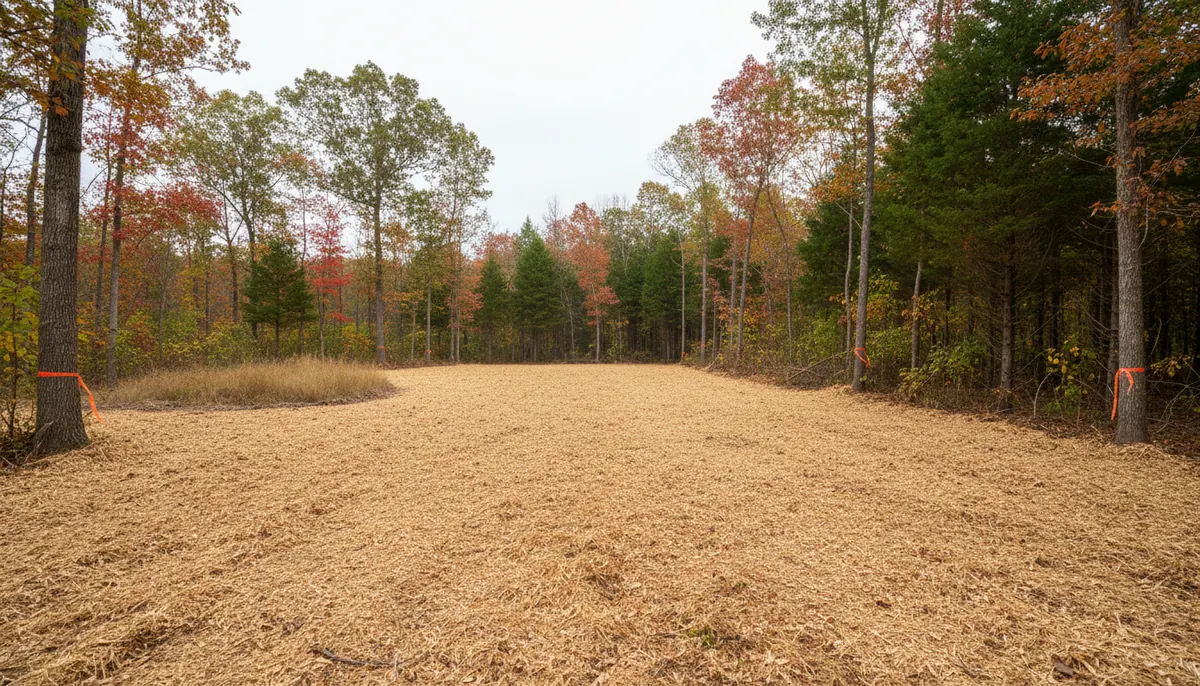
Forestry mulching in Clarksville, TN reduces standing vegetation to a fibre blanket in one pass, with no burn pile and no dump run. A high-flow carrier with a rotary drum head grinds briar, honeysuckle, volunteer stems and small trees where they grew, and the material stays as cover. The disposal line disappears from the quote and the soil is protected the hour the machine leaves.
That makes it right for idle pasture, view lines, trails and understory on wooded acreage, and wrong under a footing. If the ground has to carry concrete, read what taking the root mat out involves.
What a Mulching Pass Covers
Idle Pasture and Field Edges
Ground out of grazing carries briar and volunteer stems before trees. One pass restores a workable surface and leaves fibre holding the soil.
Understory Under a Kept Canopy
The value on wooded acreage is in the mature stems. The head works between kept trees, taking a lot from impassable to walkable.
Trails, Lanes and Sight Lines
A compact tracked carrier turns inside a narrow corridor and leaves a driveable surface.
Boundary and Corridor Work
Fence lines and easements are cut to a stated width, quoted by length rather than acre.
Heads, Carriers and Their Limits
Carrier and head as a pair
A high-flow compact track loader carrying a drum head is the working configuration; a CAT 299D3 XE Land Management machine with a Denis Cimaf DAF-180 head is one documented example. Tracks keep ground pressure low enough for soft spring ground.
Head families and the horsepower rule
Fecon builds the Bull Hog in standard flow and high flow skid steer versions plus the Blackhawk line, with excavator heads for carrier bands from 3.5 to 10 ton up through 15 to 45 ton and power take-off heads from 150 horsepower upward. The maker rule: 70 or more horsepower handles moderate brush and small trees, 100 or more suits heavy-duty clearing.
What nobody publishes
Manufacturers publish no maximum material diameter per model: it depends on carrier flow, hydraulic pressure, species and whether the stem is standing. Anyone quoting a hard maximum off a spec sheet is reading something not printed on it.
From Walkover to the Last Pass
-
Walk and measure the disturbed area
We mark what stays, note slope, gate width and turning room, and find wet ground and any blue-line stream. Disturbed acreage is measured on site, because it decides which permits apply.
-
Locate ticket and threshold check
Tennessee 811 requires at least three working days of notice, marks stay valid for 15 calendar days, and there is a 24-inch tolerance zone either side of a marked line.
-
Perimeter first, then interior
The pass starts on the boundary, then works inward. Kept stems are flagged before cutting and creek buffers staked.
-
Spread, finish and stabilise
Heavy stands leave heavy fibre, so a finishing pass spreads the mat. The stabilisation clock runs from the day work in that portion stops.
Two Things a Mulching Head Will Not Do for You
It does not take the roots, and that decides whether you can build
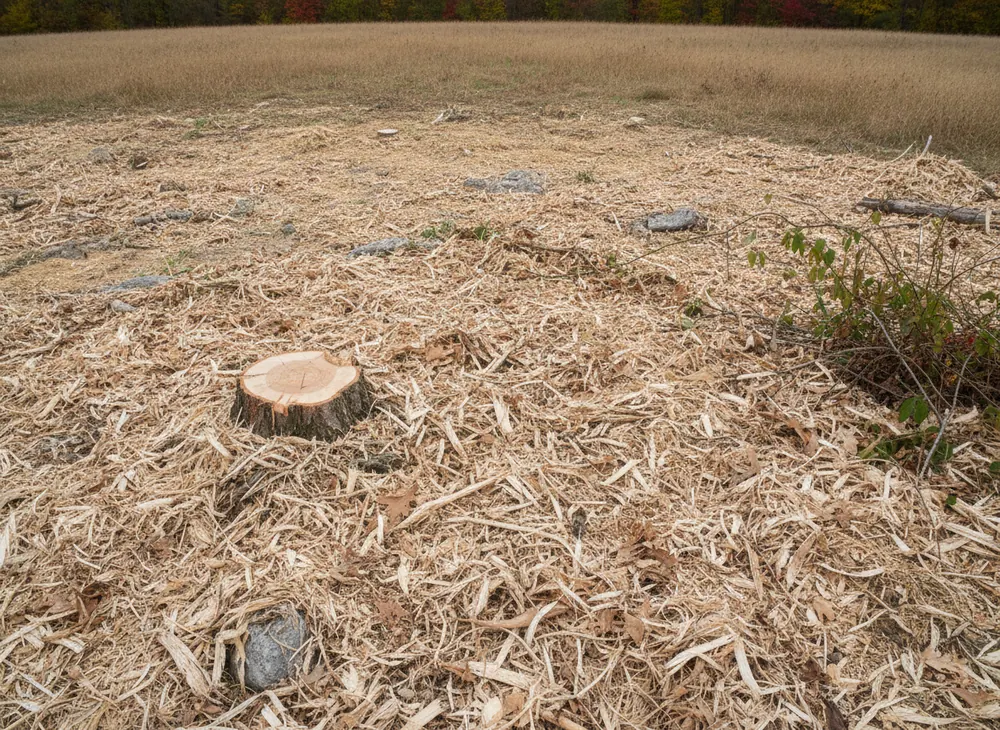
A drum head grinds to the soil surface and stops. The stump, root collar and root mat stay in the ground alive. For pasture and trails that is often preferable: an intact root network holds a slope through a wet spring. Under a structure it is a defect: organic material decomposes and loses volume under load, so a footing or slab bearing on it settles unevenly. Live root collars of oak, hickory, red maple and sweetgum sprout back from the cut, so a mulched hardwood stand regrows as a thicket. That is why grubbing sits in the highest cost band of any clearing scope in Tennessee, $2,600 to $4,160 per acre, and why the two scopes are quoted separately.
It does not exempt you from the one-acre stormwater threshold
Mulching is claimed locally to remove the permit requirement. It does not: the trigger is acreage disturbed, not the machine. The Tennessee construction stormwater general permit, TNR100000, takes coverage at clearing, grading or excavation disturbing one or more acres, and below an acre where the work is part of a larger common plan of development. The notice of intent is submitted at least 30 days before construction begins, with a site-specific stormwater pollution prevention plan. The initial fee is $250 in the 1 to 5 acre band and $1,000 from 5 to 20 acres. Montgomery County adds its own layer above one acre under Stormwater Management Regulations Resolution #13-2-2: grading, drainage and erosion control plans before any earth disturbing activity, a grading permit fee of $65 per acre, a plan review fee of $50 per acre and a $10 archives fee. What mulching changes is the erosion picture: the fibre layer is cover from day one.
Forestry Mulching Cost in Clarksville, TN
Forestry mulching in Tennessee: $1,105 to $1,950 per acre
The per-acre figure is the Tennessee band from a published 2026 state cost guide. Hourly bands guide small parcels better.
| Scope | Typical range | What it covers |
|---|---|---|
| Light underbrush | $125 to $200 per hour | 3 to 5 hours per acre. |
| Medium density | $150 to $300 per hour | Closed understory. 5 to 8 hours per acre. |
| Dense underbrush to mature stems | $200 to $275 per hour | A full stand. Under an acre per working hour. |
| Heavy brush with large trees | $300 to $400 per hour | 8 to 10 or more hours per acre. |
What moves the price
- Vegetation density, worth a three to eight times spread.
- Slope. Moderate adds 20 to 30 percent, steep or rocky 40 to 60 percent.
- Trees over 6 inches in diameter add 15 to 30 percent.
- Hidden rock and debris, another 20 to 40 percent.
- Access. A parcel a trailer cannot reach adds $500 to $1,500.
- Size. Five acres and up earns a volume discount of 10 to 25 percent.
Six acres of medium-density stand on gentle ground, gate access. At the Tennessee band that is $6,630 to $11,700 of cutting, with a 10 to 25 percent volume discount normal at that acreage. The disturbance is over an acre, so the county grading permit at $65 per acre and plan review at $50 per acre come to $690 plus the $10 archives fee, and state stormwater coverage in the 5 to 20 acre band is $1,000. At 5 to 8 hours per acre, plan three to five working days.
Working With Us on a Mulching Job
Method chosen against the end use
Pasture, a build pad and a view line are three scopes; buying the cheap one means paying mobilisation twice.
The permit position in writing
The disturbed acreage is measured on the walk and the threshold answered on the quote.
Kept stems are flagged before cutting
Anything staying is marked on the ground with you present, not decided from the cab.
Mulching Questions from Landowners
Does mulching kill the stumps and roots?
No. The head grinds to the soil surface and the root collar stays alive below it. Oak, hickory, red maple and sweetgum sprout hard from a cut collar, so a mulched hardwood stand returns as multi-stem sprouts. Where the roots must go, the scope is grubbing rather than grinding.
Will the mulch stop grass coming back?
The mat is thickest where the standing volume was highest: a heavy stand leaves a heavy layer, an open field almost nothing. A finishing pass spreads it, and on pasture ground we plan seeding around the thickest areas.
Is mulching cheaper than conventional clearing?
Usually, and the saving is in disposal rather than cutting. Traditional clearing runs $2,000 to $6,000 per acre nationally once material is piled, burned or hauled, and one published comparison puts mulching 20 to 40 percent below that.
Can you mulch in the wet season?
Better than most machines, which is the argument for tracks. March through May is the wettest stretch in Clarksville at 14.60 inches, against 2.95 in August and 3.49 in September. Dickson-series soils carry a fragipan that perches water, so ground can be soft on top and firm underneath.
What size stems will the head take?
It depends on the carrier as much as the head, which is why no per-model maximum is published. We look at what is standing and tell you which stems need tree work with a different machine.
Services That Pair With Mulching
Pulling the root mat out is the upgrade wherever a footing, slab, driveway base or septic field is going.
A straight knockdown suits a parcel that is briar rather than standing timber.
Bringing a field back into hay starts with a mulching pass and ends with the root crowns.
Keeping regrowth down on a cycle stops a cleared parcel closing back in.
Book a Site Walk on Your Acreage
Send the parcel details and we will walk the ground, measure the disturbed area, check the stormwater threshold and put a written scope in front of you before any machine is booked.