Storm Damage Cleanup in Cumberland City, TN
Downed timber, hangers and lifted root plates cleared off Stewart County property after a storm, then chipped, stacked or hauled on a decision made before the saws start.
Get a Free Land Clearing Quote in Clarksville
Tell us the acreage, the road it fronts and what the ground has to do afterwards. Form requests are answered the same working day, and every quote follows a site walk.
Cumberland City recorded 305 residents at the 2020 census, an incorporated Stewart County town on the Cumberland River sharing ZIP 37050 with a stretch of river bottom and ridge ground far larger than the town itself. Its landmark is industrial: the TVA Cumberland Fossil Plant, a 2.6 gigawatt station whose stacks rank among the tallest structures in Tennessee and are visible from at least 30 miles away. What that skyline hides is the shape of the ground under it, which is river valley, wooded ridge and long private frontage, and that is the shape that decides what a storm leaves behind.
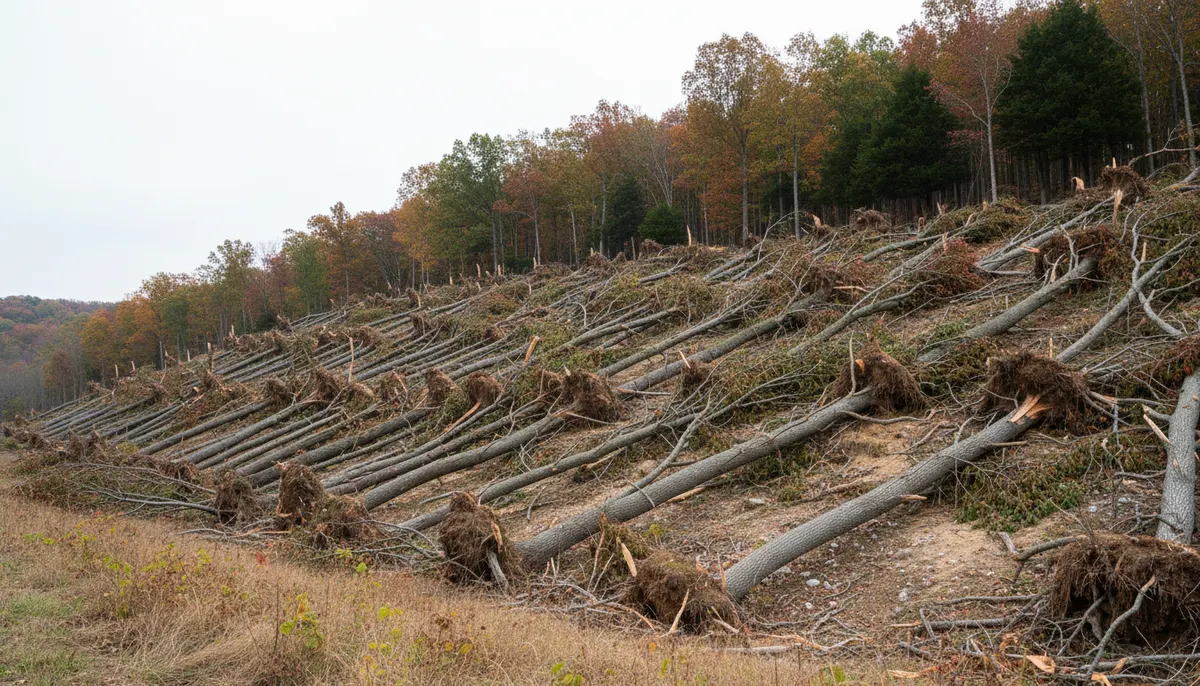
Storm work here is rarely a single tree on a lawn. It is a run of timber laid over in one direction, hangers suspended in standing crowns, split leaders that have not come down yet, and root plates tipped up with soil and rock still gripped in them. Clarksville Elite Land Clearing works storm damage on Stewart County property in the order risk demands rather than the order the pile suggests, so suspended and loaded wood is released before anything on the ground is touched. Where a storm has flattened an area rather than picked at it, the recovery is closer to a clearing job than a tree job.
Why Storms Do This Kind of Damage Around Cumberland City
Three things set what a storm leaves on this ground: what is growing on it, what the subsoil does with water beforehand, and how far the debris has to travel afterwards.
What is standing, by volume and by stem
Statewide inventory puts yellow-poplar at 11.6 percent of growing stock volume, white oak at 9.2 percent and chestnut oak at 8.2 percent, while by stem count the order changes to red maple at 9.6 percent, yellow-poplar at 6.9 percent and sweetgum at 5.6 percent. That gap between volume and stem count is the storm cleanup gap. The volume species are what lands across a drive or a roof and needs bucking before it moves. The stem count species are the understory and edge growth that comes down in tangled quantity and fills a trailer faster than anyone expects, and a quote that counts only the big stems misses most of the day.
Wet subsoil and lifted root plates
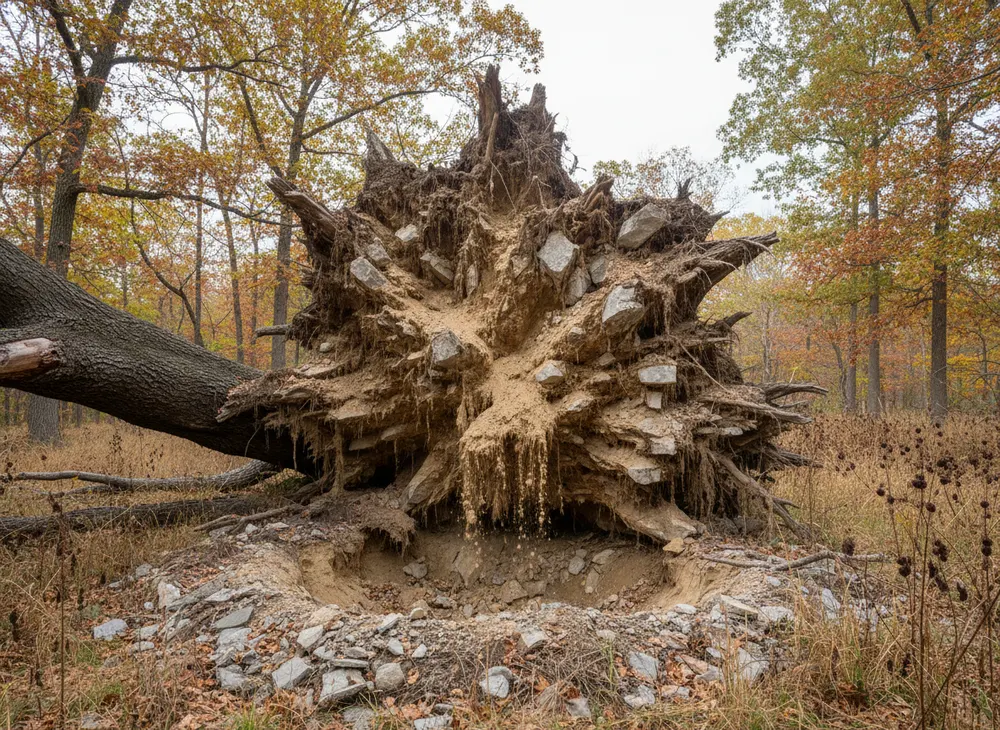
Dickson, the Tennessee state soil, is a silt loam over a fragipan, a dense restrictive layer that perches water above it rather than letting it drain away. Ground holding water under the root zone gives up its grip differently from ground that drains, which is why wind on saturated soil tips root plates instead of breaking stems. The nearest long rainfall record, at Clarksville, shows 50.99 inches a year, May wettest at 5.72 inches, with December and November behind it at 4.94 and 4.51 inches, so wet ground and the wind season overlap. A lifted plate leaves a void to be filled and compacted, not just cut off.
Where the debris goes, and how far
Stewart County is thin on the municipal green waste infrastructure a city crew leans on. Dover, the county seat, was recorded as 100.0 percent rural at the 2020 census, which describes the disposal problem as well as the settlement pattern. That leaves three options for storm material: chip and spread it on site, stack and burn it inside the legal season, or load and haul it. Haul distance is a real cost line here, so the debris decision is settled before the first cut and priced as its own item.
Storm Cleanup Rules and Permits in Cumberland City, TN
Cumberland City is in Stewart County, which is a different local jurisdiction from Montgomery County and carries its own requirements. The statewide layer is the part that is fully sourced, and it is the part that governs most storm work. Facts here were checked on 30 July 2026.
Burning storm debris is a seasonal permit and a short list of what may go on the pile
From 15 October through 15 May a Tennessee Division of Forestry burn permit is required for debris pile fires, and storm debris is named on the list of material that needs one. The permit is valid for a single day and must be obtained on the day of burning, with a firebreak of at least 3 feet through leaves or short grass and 5 feet through tall grass or brush, and neighbours notified two days ahead on wooded land. TDEC air rules under 1200-03-04 allow branches, limbs, twigs and woody vegetation but prohibit building material and construction debris, so a shredded outbuilding cannot join the brush pile. Reported conditions include constant supervision, a 48-hour maximum, no more than twice in 30 days, and written consent from neighbours within 100 feet of occupied buildings. Violations can carry fines up to $25,000.
Debris from another property cannot be burned here
The same TDEC rules exclude most vegetation not grown on site. That clause governs how a multi-property cleanup gets organised, because material cannot be consolidated onto whichever parcel has the most room for a fire. Each property burns what grew on it, or the material moves to a facility. The Stewart County and town requirements sitting alongside the state rules were not verified to publication standard for this page, so no local threshold or fee is quoted here, and we confirm the correct county counter for your parcel before work is scheduled.
The state rules that catch storm work when it gets bigger
Two triggers turn a cleanup into a permitted project. The first is acreage: the construction stormwater general permit, TNR100000, is keyed to clearing, grading or excavation disturbing one or more acres, so once cleanup crosses into stripping and regrading a flattened block, the notice of intent goes in at least 30 days ahead. The second is water: pulling a root plate out of a stream bank, filling a wetland or crossing a drainage with equipment can require a TDEC Aquatic Resource Alteration Permit or a Section 401 certification, with the fee at $50 for a personal residence or family farm and general permits typically taking three to four weeks. Under all of it sits Tennessee 811, three working days notice under TCA 65-31-101, before a stump or plate is dug out.
Sources for the requirements above:
- Tennessee Division of Forestry burn permits, season, firebreak and neighbour notice (https://www.tn.gov/tnwildlandfire/prevention/safe-debris-burning/permits.html)
- TDEC open burning rules, material lists and conditions under 1200-03-04 (https://www.tn.gov/environment/air/open-burning.html)
- TDEC NPDES construction stormwater permit TNR100000 and its one-acre trigger (https://www.tn.gov/environment/permit-permits/water-permits1/npdes-permits1/npdes-stormwater-permitting-program/npdes-stormwater-construction-permit.html)
- TDEC Aquatic Resource Alteration Permit, triggering activities, fees and timeframes (https://www.tn.gov/environment/permits/water/aquatic-resource-alteration-permit--arap-.html)
- Tennessee 811 notice requirements and tolerance zone, TCA 65-31-101 (https://www.tenn811.com/faq)
Areas We Cover Around Cumberland City
ZIP 37050 is the working boundary for this page, and it takes in more river frontage and wooded ridge than town. The TVA Cumberland Fossil Plant is the reference point everyone uses to give directions, and the Wells Creek impact crater lies just south of it, which is a reminder that the ground here is not uniform and that what comes up under a tipped root plate is not always the soil profile you expected from the surface.
River frontage changes the work twice over. Fallen timber on a bank is a stability question as much as a cleanup question, because the root mass now lying sideways was holding that bank, and cutting it flush without a plan for the exposed face trades one problem for another. It is also where a permit question is most likely to appear, since anything putting equipment or fill into a watercourse leaves the ordinary cleanup category, and holding a raw bank afterwards is a stabilisation scope of its own.
Access is the other variable. Long private drives under standing timber are common here, and the first task after a storm is usually opening the drive far enough to get a truck and chipper to the damage. Downriver the same conditions run through the Stewart County seat at Dover, and upriver they continue into the Montgomery County bottoms.
Land Clearing Services Available in Cumberland City
Four scopes that come up on Stewart County property, before and after weather.
Storm Damage Cleanup
Suspended and loaded wood first, then ground timber bucked, dragged and processed. Root plate voids filled and compacted rather than trimmed off at grade. The debris route is decided at the quote stage.
Tree Removal
For the damaged stems that are still standing: split leaders, cracked unions and leaning trunks over a structure or a drive. Taken down in controlled sections where the drop zone will not allow a felling cut.
Land Clearing Debris Removal
The second half of every storm job. Chipping on site, stacking for a legal seasonal burn, or loading and hauling, priced as its own line because the material volume is what actually drives it.
Stump Grinding
What is left after the wood is gone. Ground out below grade so the area can be mowed or built on, with the utility locate placed before any cutting wheel goes into soil.
How We Work in Cumberland City
-
Assess loaded wood before anything else
Hangers, bent stems and split unions carry stored energy and they are what hurts people during cleanup. They are identified and released first, before the ground pile is touched.
-
Settle the debris route
Chip, seasonal burn or haul, decided against the burn season, the material rules and the haul distance from your parcel, then written into the quote instead of left open.
-
Finish the ground, not just the wood
Plate voids backfilled, ruts from the extraction route repaired, and any bank or drainage question flagged with the permit path named rather than quietly worked around.
Nearby Communities We Serve
Farm clearing around Erin covers Houston County to the south, entirely rural, gently rolling and worked with the same equipment we bring here.
Selective clearing at Palmyra is the head service upriver in southwest Montgomery County, where the same Cumberland frontage carries a different set of county rules.
Stump grinding in Woodlawn is the US 79 corridor between here and Clarksville, unincorporated ground with the same long private drives.
Book a Site Walk on Your Acreage
Send the parcel details and we will walk the ground, measure the disturbed area, check the stormwater threshold and put a written scope in front of you before any machine is booked.