Brush Clearing in Pleasant View, TN
Overgrown fencerows, reverted pasture and thicket cut back to usable ground across northern Cheatham County, priced by how dense it actually is.
Get a Free Land Clearing Quote in Clarksville
Tell us the acreage, the road it fronts and what the ground has to do afterwards. Form requests are answered the same working day, and every quote follows a site walk.
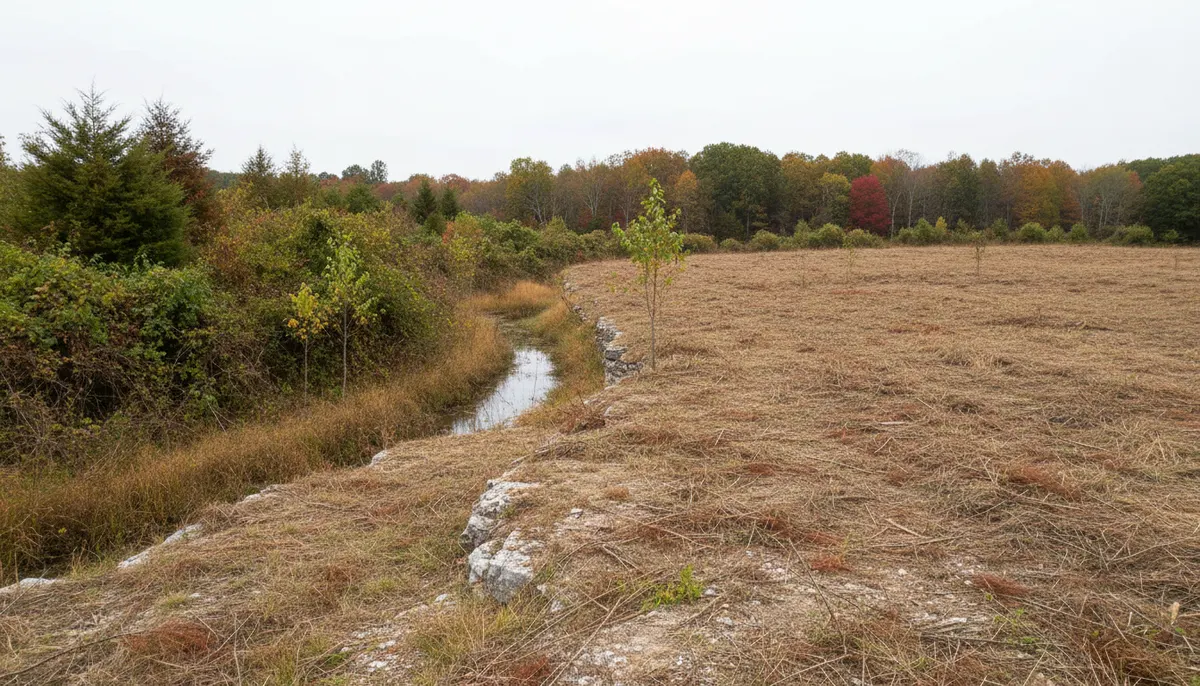
Pleasant View sits on the northern border of Cheatham County, Tennessee, covering 12.6 square miles with roughly 55 city streets and about 24 road miles inside its limits. It was first incorporated in 1921 and re-incorporated in 1996 under a mayor and aldermanic charter, and it counted 4,807 residents at the 2020 census against an estimated 5,629 by 2024, which is around 800 more people in four years. Growth arriving that way, into a town bounded by Goodsprings Road, Triangle Road, Old Clarksville Pike and Oaklawn Road, means a great many parcels here have gone from farmed to idle to overgrown while waiting to become something else.
Brush clearing is the scope that ground needs. Clarksville Elite Land Clearing cuts back fencerows, reverted pasture, hedgerow and thicket in northern Cheatham County, priced by vegetation density class rather than a single acre rate, because an acre of waist-high blackberry and an acre of eight-year sapling growth are not the same job. Where growth has thickened past the point a brush cutter is sensible, a mulching head is the cheaper pass, and where specific trees are to stay standing in the middle of it, that is a selective job with a marked keep line.
Why Pleasant View Ground Goes to Brush So Fast
Three local facts explain why a field here closes in within a few seasons, and what that does to the price.
Perched water and the wet spots it creates
Dickson, the Tennessee state soil, is a silt loam with a fragipan, a dense restrictive layer in the subsoil that holds water above it after rain instead of letting it drain away. Mountview is the well-drained series alongside it on the same Highland Rim ground. The effect is patchy rather than uniform. Parts of a field stay damp for days after a storm while thirty yards away the surface is dry, and the damp patches carry the heaviest brush. That is why we walk a field before quoting rather than measuring it off a map.
The species that come back first
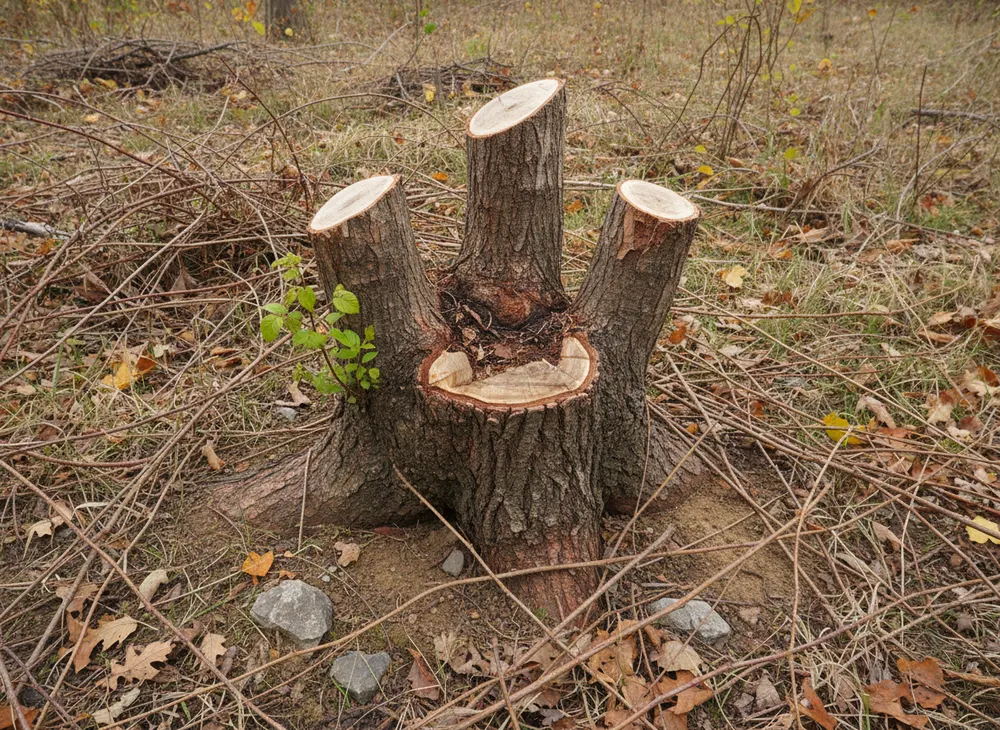
The Forest Service inventory for Tennessee ranks red maple first by stem count at 9.6 percent, followed by yellow-poplar at 6.9 and sweetgum at 5.6, while the oak and hickory type group accounts for 69.7 percent of forest land overall. That stem-count order is what a neglected field looks like at year five. Maple and sweetgum colonise open ground quickly and resprout hard from a cut stump, which is why a brush job done without addressing the stump comes back thicker than it went.
Rain spread through the year, and a lot of edge
The nearest published long-term record in this metro puts annual precipitation at 50.99 inches, with 14.60 inches falling across March, April and May alone and a driest month of 2.95 inches in August. Rain distributed that evenly, in hardiness zones 7a and 7b, means there is no dormant season here in the sense a drier climate would recognise, and a field cut once in spring is often not still clear in September. Add roughly 55 streets and 24 road miles inside 12.6 square miles and you get a great deal of edge, which is where brush lives, and where fence line work is often the more accurate scope.
Brush Clearing Permits and Requirements in Pleasant View, TN
Pleasant View is in Cheatham County. The Tennessee rules below apply statewide and therefore here. The county layer is described but not quantified, because it is not verified. Checked 30 July 2026.
Burning, which is where most brush jobs end up
A Tennessee Division of Forestry burn permit is required from 15 October through 15 May for debris pile fires and prescribed fires, and outside that window a state permit is not required for summer burning. The permit is obtained on the day of the burn and is valid for that day only. The firebreak requirement is at least three feet through leaves or short grass and at least five feet through tall grass or brush, and neighbours are notified two days in advance for burns on wooded land. Leaf piles, woody debris, branches and storm debris require the permit.
What may and may not go on the pile
Under the Tennessee air pollution control regulations at chapter 1200-03-04, what may be burned is leaves, branches, limbs, twigs, lawn clippings, woody vegetation, yard trimmings and clean untreated wood, subject to local ordinances. What may not includes tyres and rubber, vinyl siding, plastics, paper and cardboard, asphalt roofing, paints and chemicals, construction debris, coated wire, household waste, and most vegetation not grown on site. TDEC reports conditions of constant supervision, a 48-hour maximum duration, no more than twice in 30 days, and written neighbour consent within 100 feet of an occupied building, with penalties up to $25,000. That last clause is the operational one, because brush hauled in from another parcel cannot legally be burned on yours.
When brush clearing becomes a stormwater job
The Tennessee construction stormwater general permit, number TNR100000, is triggered by clearing, grading or excavation producing an area of disturbance of one or more acres, or less where the work forms part of a larger common plan of development. Cutting brush without disturbing soil is a different thing from stripping ground, and most straightforward brush jobs here do not reach that trigger. We say so plainly rather than implying every job needs a permit, and equally we do not claim a brush cutter exempts a large disturbance, because the permit is written around area disturbed rather than equipment type.
The Cheatham County and Pleasant View layer
The town and the county run their own land disturbance approvals independently of the state process and of neighbouring counties. We have not verified the Pleasant View or Cheatham County thresholds, submittals or fees to publication standard, so no figure appears here, and nothing from Montgomery County has been carried across. Local burning restrictions can sit on top of the state permit, including seasonal bans, so the local position is confirmed for your address before a pile is lit.
Locates and licensing
Tennessee 811 requires at least three working days notice, which is 72 hours excluding weekends and holidays, under Tennessee Code 65-31-101, with a tolerance zone of two feet each side of the marked facility and a ticket valid for 15 calendar days. A contractor licence is required at a total project cost of $25,000 or more, and the classification covering this scope directly is HC-5, Clearing, Grubbing, Snagging and Rip Rap.
Sources for the requirements above:
- TDF burn permits, season and firebreak widths (https://www.tn.gov/tnwildlandfire/prevention/safe-debris-burning/permits.html)
- TDEC open burning under TAPCR 1200-03-04 (https://www.tn.gov/environment/air/open-burning.html)
- TDEC stormwater permit TNR100000 (https://www.tn.gov/environment/permit-permits/water-permits1/npdes-permits1/npdes-stormwater-permitting-program/npdes-stormwater-construction-permit.html)
- Tennessee 811 law (https://www.tenn811.com/law)
- Contractor licensing, the $25,000 threshold and HC-5 (https://www.tn.gov/commerce/regboards/contractors/license/get/contractor.html)
- Forests of Tennessee FIA snapshot (https://www.srs.fs.usda.gov/pubs/ru/ru_fs483.pdf)
- Dickson series and its fragipan (https://soilseries.sc.egov.usda.gov/OSD_Docs/D/DICKSON.html)
Areas We Serve in and Around Pleasant View
The town is bounded by Goodsprings Road, Triangle Road, Old Clarksville Pike and Oaklawn Road, and those four names describe the working area better than a radius would. Inside them the pattern is residential lots backing onto fields that used to be farmed. The boundary between a mowed half acre and an unmanaged five behind it is where most calls come from.
Old Clarksville Pike is the historical axis, the road the town grew along before the modern routes took the traffic, and frontage parcels on it carry the oldest fencerows in the area. Old fencerow is dense fencerow. Decades of undisturbed hedgerow growth on a boundary is a different job from four seasons of regrowth in an open field, because it has to be worked from one side with the fence itself as a constraint.
Pleasant View Community Park and Balthrop Park are the two public open spaces, and they mark the parts of town where mowed ground meets unmanaged ground on a large scale. Out toward the town limits the parcels get bigger and access gets simpler, and that is where a brush job stops being a careful trim and starts being an acreage pass.
Northern Cheatham County is a boundary zone administratively too. The county line runs along the northern edge of town, so a parcel a mile north answers to a different county entirely, which matters for the local permit step and for who to call about a burn. South of here the county runs down to the river and hill grading work at Ashland City, and northeast the country opens toward the lot clearing market at Springfield.
Land Clearing Services Available in Pleasant View
Four scopes that cover most overgrown-ground problems in northern Cheatham County.
Brush Clearing
Fencerow, thicket, reverted pasture and hedgerow cut back to usable ground, priced by density class rather than a flat acre rate. The stump decision is made explicitly.
Bush Hogging
Rotary cutting on ground that is still field rather than thicket, run on a maintenance interval instead of as a one-off rescue. Far cheaper per acre once a field is back.
Forestry Mulching
One machine grinding standing brush and small stems in place, leaving the residue as a surface mat. The right answer once growth has passed brush cutter size.
Selective Clearing
Taking out the understorey and unwanted stems while leaving marked trees standing. Worth it where the value of the parcel is in what stays.
How We Work in Pleasant View
-
Walk it and classify the density
Stem size, species, how wet the low ground is and where the fencerows run. Density class cannot be read off a satellite image.
-
Decide what happens to the material
Burn inside the state season with a permit taken on the day, chip on site, mulch in place or haul out. The local Cheatham County position is confirmed for your address first.
-
Cut, then set an honest interval
The first pass on closed ground costs the most. We finish with a realistic maintenance interval, which on this rainfall and this soil is shorter than people expect.
Nearby Communities We Serve
Land grading at Ashland City is the Cheatham County seat south of here on the Cumberland River, same permit office, very different ground.
Lot clearing in Springfield is northeast across the line in Robertson County, where parcels are being cleared for building rather than reclaimed from brush.
Land clearing for home building at Sango sits northwest in Montgomery County, the same growth pressure arriving under a different set of rules.
Book a Site Walk on Your Acreage
Send the parcel details and we will walk the ground, measure the disturbed area, check the stormwater threshold and put a written scope in front of you before any machine is booked.