Site Preparation in Clarksville, TN
Everything between raw ground and a pad a footing crew can work on: locates, clearing, grubbing, topsoil, earthwork, compaction and the erosion controls the permit expects.
Get a Free Land Clearing Quote in Clarksville
Tell us the acreage, the road it fronts and what the ground has to do afterwards. Form requests are answered the same working day, and every quote follows a site walk.
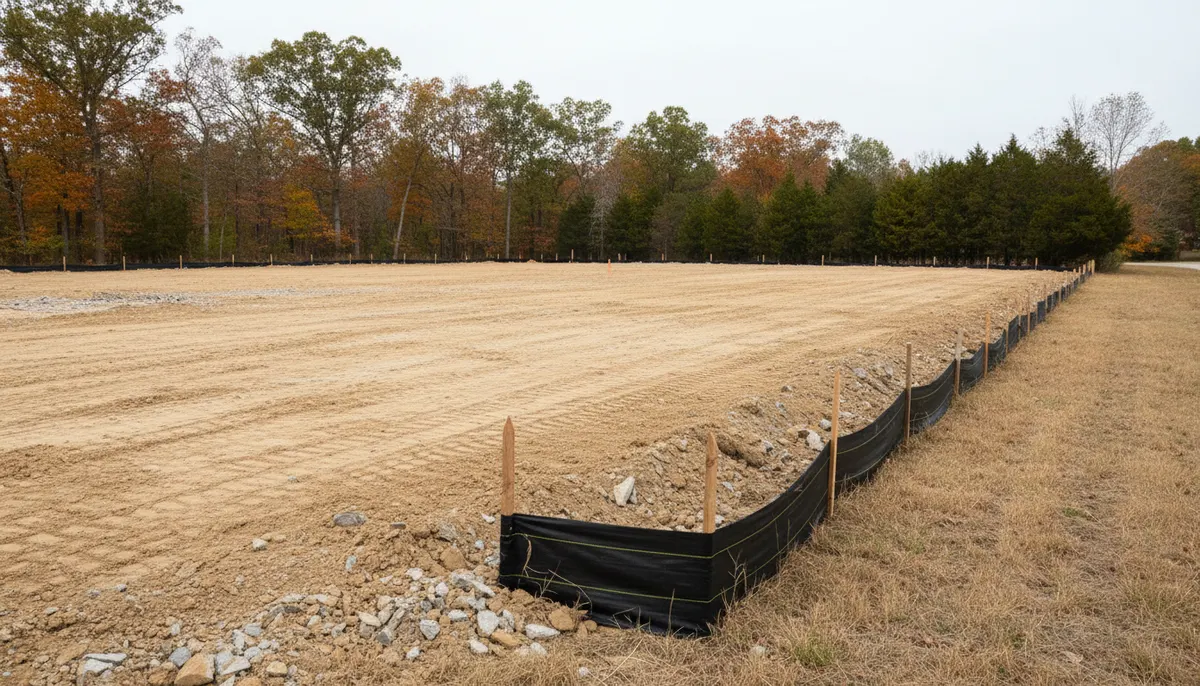
Site preparation services in Clarksville, TN start weeks before a machine moves, because the paperwork runs a longer lead time than the earthwork. The state construction stormwater application goes in at least 30 days before work starts, and Montgomery County requires grading, drainage and erosion control plans before any earth disturbing activity begins.
The physical work runs in a fixed sequence, set out below. What separates site prep from opening up a parcel is a specified result, finished when the ground is at grade, compacted, drained and documented.
What Gets Prepared, and to What Standard
Four scopes with different tolerances.
Residential build pads
A grubbed, stripped and compacted footprint at plan levels, with fall away from the structure and the pad oversized past the building line.
Commercial and industrial pads
Inspection obligations run the life of the job. The county requires grading, drainage and erosion control plans on commercial, industrial, assembly and educational projects over one acre.
Access, laydown and the drive
Every trade arrives on the access route, so it is built early to carry a loaded concrete truck.
Septic and utility areas
Most rural fringe lots are unsewered, so the drain field is cleared, kept free of root mass and protected from traffic.
Licensing, Certification and Who Is Allowed to Do What
Tennessee is specific about this. Ask which classification a bidder holds.
The $25,000 threshold and classification HC-5
A Tennessee contractor licence is required when the total cost of the project is $25,000 or more, issued by the Board for Licensing Contractors. The classification covering this work exactly is HC-5, Heavy Construction, whose published scope reads "Clearing, Grubbing, Snagging and Rip Rap".
The neighbouring classifications
BC-13 covers Site and Subdivision Development. HRA-A and MU-C both cover Grading and Drainage, including drainage pipe and structures, clearing and grubbing. BC-28 covers Excavation, with a note that excavation contractors should check with the Department of Environment and Conservation.
EPSC Level 1, and who inspects your controls
Montgomery County requires stormwater controls inspected by someone holding Tennessee EPSC Level 1 certification twice a week, no less than 72 hours apart, with an inspection documented before and after a rain event. That certification is the TDEC course in Fundamentals of Erosion Prevention and Sediment Control, 7.0 hours at $150.
The Sequence, Start to Handover
-
Survey and fix the disturbance figure
We locate the building envelope, find the fall, note wet ground and any blue-line stream, and measure the soil area to be disturbed. That figure decides the permits.
-
Permits, plans and notices
Above an acre, Resolution #13-2-2 requires grading, drainage and erosion control plans before earth disturbing activity begins, and permit TNR100000 needs a notice of intent 30 days ahead.
-
Clear to the limit of work
Everything inside the marked limit comes off, the riparian buffer stays, and perimeter controls go in as ground opens.
-
Grub the root mat and strip the topsoil
Roots, stumps and root mat come out of the footprint, then topsoil is stripped separately and stockpiled clear of the drainage path.
-
Cut, fill and compact to design levels
Fill is placed and compacted in lifts, and the subgrade drains away from the structure.
-
Install controls, stabilise and hand over
Silt fence, check dams and inlet protection go in and get documented. Stabilisation is due within two weeks after activity in that portion ceases, one week on slopes.
Two Details That Decide Whether the Pad Holds Up
The 30-day notice is a schedule line, not a formality
The most expensive thing on a site prep job is a stalled crew, usually caused by a permit position checked too late. Coverage under the Tennessee construction general permit TNR100000 is triggered by clearing, grading or excavation disturbing one or more acres, and by disturbance under an acre forming part of a larger common plan of development. The application should go in at least 30 days prior to commencement, with a site-specific stormwater pollution prevention plan alongside it. Initial fees run $250 at 1 to 5 acres and $1,000 at 5 to 20 acres, with annual maintenance of $125 and $500 past a year. The county adds a grading permit at $65 per acre, plan review at $50 per acre and a $10 archives fee. The honest lead time between deciding to build and legally opening ground is a month, not a week.
Organics under a pad are a defect, and topsoil is a material you are throwing away
Topsoil and structural fill are opposites. The horizon you want on the lawn is the one you cannot leave under a footing, because organic matter loses volume as it decomposes and compresses under load. A slab bearing on ground that still holds root mass or buried topsoil settles unevenly, and differential settlement is what cracks concrete and racks door frames. The discipline is two operations: grub the root mat out of the structural footprint, then strip topsoil in its own pass and stockpile it for reuse. The other half is placing fill in lifts and compacting each one, rather than end-tipping a heap and tracking over the top.
Budgeting a Site Prep Package
Land clearing in Tennessee: $1,300 to $4,500 per acre, before grubbing and earthwork
Site prep is several scopes stacked, so it is budgeted in parts. Per-acre bands are Tennessee figures from a published 2026 state cost guide.
| Scope | Typical range | What it covers |
|---|---|---|
| Clearing the vegetation | $1,300 to $4,500 per acre | Set by density, slope and access. |
| Grubbing roots and stumps | $2,600 to $4,160 per acre | The highest band of any clearing scope in Tennessee. |
| Grading and levelling | $2,000 to $5,000 on small sites | Cut, fill and shaping. An alternate national source puts it at $1,000 to $3,300. |
| Machine and operator by the day | $2,600 to $4,000 per day in Tennessee | The reference where per-acre pricing stops describing the work. |
What moves the price
- Disturbed acreage, which sets the earthwork quantity and the permit position.
- Slope, adding 20 to 30 percent on moderate ground and 40 to 60 percent on steep or rocky ground.
- Duration, because a project running past a year picks up the annual stormwater maintenance fee.
A two-acre commercial pad on gently sloping ground in medium vegetation. Clearing at the Tennessee general band is $2,600 to $9,000, grubbing the footprint sits in the $2,600 to $4,160 per acre band, and grading runs $2,000 to $5,000. Two acres of disturbance means a county grading permit at $65 per acre and plan review at $50 per acre, $230 plus the $10 archives fee, and state stormwater coverage at $250.
What We Bring to a Site Prep Contract
The permit calendar is built into the programme
Thresholds are measured and stated on the quote, with the 30-day notice shown as a date.
Controls go in as the ground opens
Perimeter protection goes in with the clearing, and stabilisation is scheduled against the two-week and one-week deadlines.
Site Preparation Questions from Builders and Owners
How is site preparation different from land clearing?
Clearing removes vegetation. Site preparation delivers a specified surface: root mat out of the footprint, topsoil stripped and stored, levels matching the design, subgrade compacted in lifts, water falling away from the building.
When does the permit clock actually start?
The state notice of intent goes in at least 30 days before construction commences, and the county requires grading, drainage and erosion control plans before any earth disturbing activity begins. The 811 locate is a shorter clock at three working days.
Who has to inspect the erosion controls, and how often?
Someone holding Tennessee EPSC Level 1 certification, twice a week, no less than 72 hours apart, plus before and after a rain event. The state permit adds that sites over 50 acres are inspected after any rainfall over 0.5 inches in 24 hours.
Can the pad be built in spring?
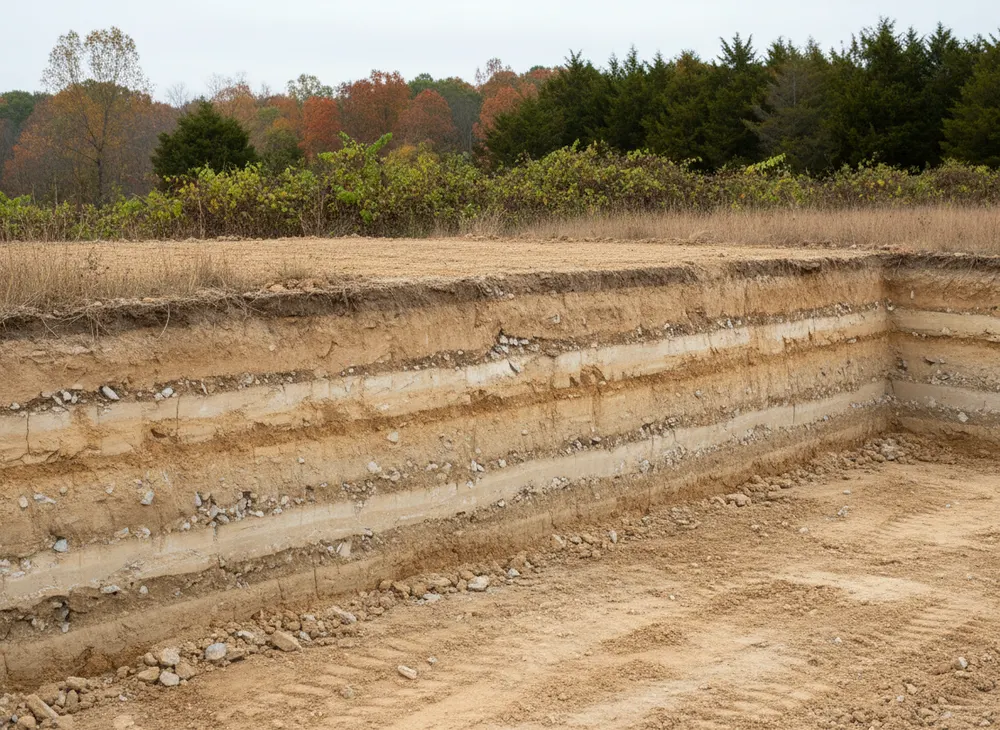
Compaction is moisture sensitive, and this county gets 14.60 inches of rain across March, April and May against 6.44 across August and September. Dickson-series soils carry a fragipan that perches water above a dense layer, so ground stays wet after the rain stops. We plan the window around what the surface has to drain to.
Scopes That Make Up or Follow Site Prep
Getting the roots and the root mat out makes ground capable of carrying a footing, and it is the most expensive band here.
Cutting the levels and setting the fall is where the pad gets its shape, and with a fragipan underneath, drainage matters more than surface finish.
Meeting the stabilisation deadlines is a permit obligation over an acre, with silt fence and seeding on a two-week clock.
Digging below the prepared surface covers footings, trenches and ponds, where this county limestone makes void risk real.
Book a Site Walk on Your Acreage
Send the parcel details and we will walk the ground, measure the disturbed area, check the stormwater threshold and put a written scope in front of you before any machine is booked.