Storm Damage Cleanup in Clarksville, TN
Downed timber, hung-up limbs and lifted root plates cleared after a wind event, then chipped, hauled or burned inside the rules that apply that month.
Get a Free Land Clearing Quote in Clarksville
Tell us the acreage, the road it fronts and what the ground has to do afterwards. Form requests are answered the same working day, and every quote follows a site walk.
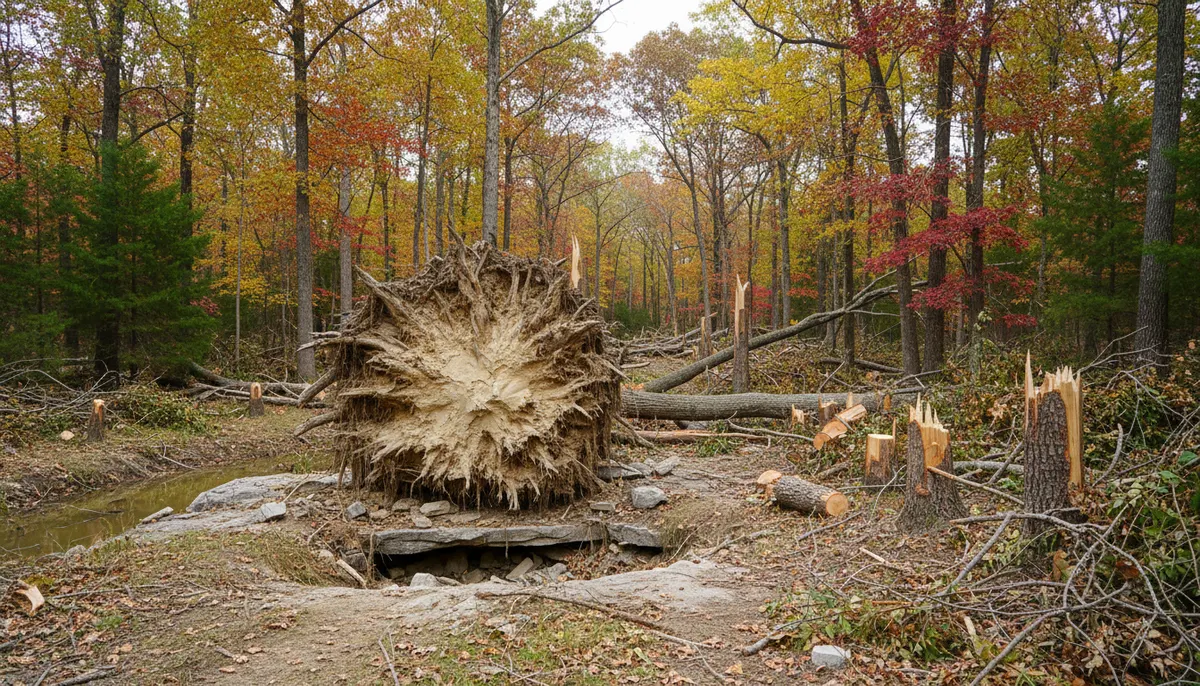
Storm damage cleanup services in Clarksville, TN are priced by what is still holding load, not by how much wood is lying flat. The limb wedged in a neighbouring crown and the root plate standing vertical are what set the method and the hours.
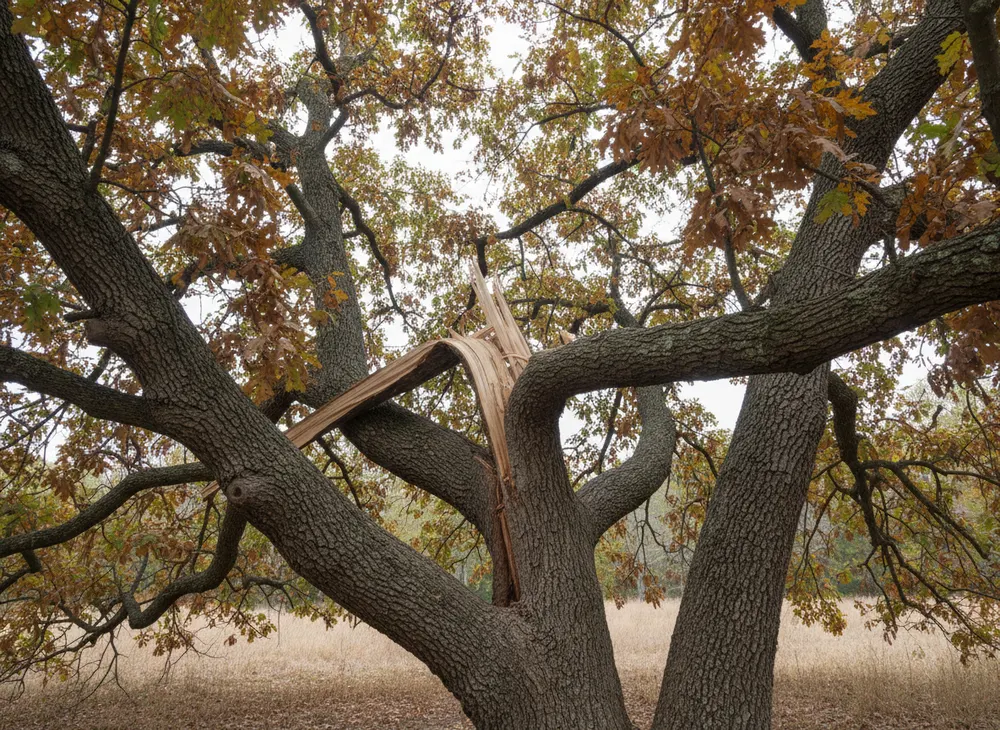
What a Wind Event Actually Leaves
Hangers loaded in the canopy
Limbs held by a strip of bark. They store energy and do not fall on a schedule, so the ground below is closed first.
Lifted root plates
A tree tipped with the root mass vertical and a void behind it. Cutting the stem can spring the plate back into the hole. Excavator work.
Leaners resting on something
A stem held by a fence, a shed or another tree. Release it in the wrong order and the tree moves.
Blocked access and buried fence
Cutting an access lane first is cheapest, since it lets a truck reach the rest.
Machines Matched to the Hazard
Excavator with a thumb
For root balls, for lifting a stem under tension instead of cutting it, and for stacking material.
Track loader with a mulching head
Where a storm flattened brush across an area. Fecon publishes the rule: 70 or more horsepower handles moderate brush, 100 or more heavy clearing.
Chipper and haul truck
The disposal end. Chipping is priced by the hour, hauling by the load.
How We Work a Storm Site
-
Mark what is still loaded
Hangers, tensioned stems and open root voids identified, exclusion zone set.
-
Release the suspended wood
Hangers come down first, so nobody works under stored load.
-
Cut, separate and stage
Brush one pile, stem wood another, root plates a third. Separating keeps disposal down.
-
Pick the disposal route
Chip, haul or burn, decided by volume, access and the calendar.
Burning Storm Debris in Tennessee, Rule by Rule
Seasonal permit, valid one day
From 15 October through 15 May a Tennessee Division of Forestry burn permit is required for debris pile fires and prescribed fires. State permits are not required during the summer months, which is the reverse of what most people assume. The permit is valid one day only and has to be obtained on the day of the burn, so one pulled on a Friday is worthless on the Saturday. It carries physical conditions as well as paperwork: a firebreak at least three feet wide through leaves or short grass, and at least five feet wide through tall grass or brush. Burns on wooded land require neighbours to be notified two days in advance.
The air rules, and the clause that catches storm work
Tennessee Air Pollution Control Regulations 1200-03-04 govern what may go on the pile. Leaves, branches, limbs, twigs, woody vegetation and clean unpainted, uncoated wood are allowed. Construction debris, treated or coated wood, asphalt shingles, plastics and household trash are not, and violations can carry fines up to $25,000. Three conditions apply: constant supervision, a 48-hour maximum duration, and no more than twice in any 30 days. Written consent is required from occupied buildings within 100 feet, which on a subdivision lot usually means more than one neighbour. The clause that catches storm cleanup is the ban on burning most vegetation not grown on the site. Pooling debris from several properties onto whichever parcel has room is exactly what people do after a wind event, and that pile is no longer legal. Material leaving the ground it grew on leaves as chip or as loads.
What Storm Cleanup Costs Here
$150 to $200 per pickup load hauled, or $100 to $150 per hour to chip on site
Published 2026 cost-guide ranges. The hazard, not the volume, sets the hours.
| Scope | Typical range | What it covers |
|---|---|---|
| Failed or hazardous tree | $400 to $1,200 per tree | Tensioned stems sit at the top of the band. |
| On-site chipping | $100 to $150 per hour | No permit season, and the chip can stay as cover. |
| Hauling brush | $150 to $200 per full pickup load | One load is roughly 2 to 4 cubic yards. |
| Larger volumes | $150 to $350 per yard waste load, or $275 to $700 for a 20-yard dumpster | Worth pricing past a few pickup trips. |
| Stump and root plate | $2 to $6 per inch, $80 to $160 minimum | Pulling a root ball instead runs $100 to $400. |
What moves the price
- How much wood is suspended or under tension.
- Whether an excavator can reach the root plate.
- Ground condition, since storms arrive with rain.
- Whether burning is legal on that parcel that month.
- Distance from pile to truck.
A worked example. One 28-inch oak uprooted across a drive, two stems snapped mid-trunk, hangers in a third. The removals fall across the $400 to $1,200 band, and four hours of chipping at $100 to $150 per hour clears the brush with no haul charge.
How We Quote Storm Work
The hazard is named, not just the count
A quote saying three trees tells you nothing. Ours names which stems are loaded.
The burn calendar is checked first
If your date sits inside the permit season we say so at quote stage.
Access before everything else
Where a drive is blocked, that lane is cleared first.
Storm Cleanup Questions
Can I burn the debris myself instead of paying to have it hauled?
Between 15 October and 15 May you need a Division of Forestry permit, taken out on the day of the burn and valid only that day, with a firebreak of at least three feet through leaves or five through tall grass.
Why does a hanging limb cost more than the tree already on the ground?
Because it is still storing energy. Suspended wood is released from a rope or a machine rather than cut free. A stem already down has no stored load.
What happens to the hole a root plate leaves?
It gets closed, either by pushing the plate back into the void and compacting in lifts, or by cutting it off and backfilling. An open void is how a pasture produces a hoof injury.
Do you take the wood or leave it?
Either. Stem wood cut to firewood lengths and stacked costs less than moving it.
Does storm cleanup trigger a stormwater permit?
Cutting downed timber does not disturb soil. The ground work after it can. Coverage under the Tennessee Construction General Permit turns on clearing, grading or excavation disturbing one or more acres, with the notice of intent due 30 days ahead.
What Usually Follows a Storm Call
Getting the pile off the property is the larger half of most storm bills once the tree work is done.
Taking what is left of the trunk below grade is quoted per inch and is cheaper booked with the cleanup than as a return visit.
Holding soil on a slope that lost its cover matters where a root plate came out on a grade.
Book a Site Walk on Your Acreage
Send the parcel details and we will walk the ground, measure the disturbed area, check the stormwater threshold and put a written scope in front of you before any machine is booked.