Fence Line Clearing in Clarksville, TN
A corridor cut to an agreed width along your boundary, with the line established and the locates placed before the head turns.
Get a Free Land Clearing Quote in Clarksville
Tell us the acreage, the road it fronts and what the ground has to do afterwards. Form requests are answered the same working day, and every quote follows a site walk.
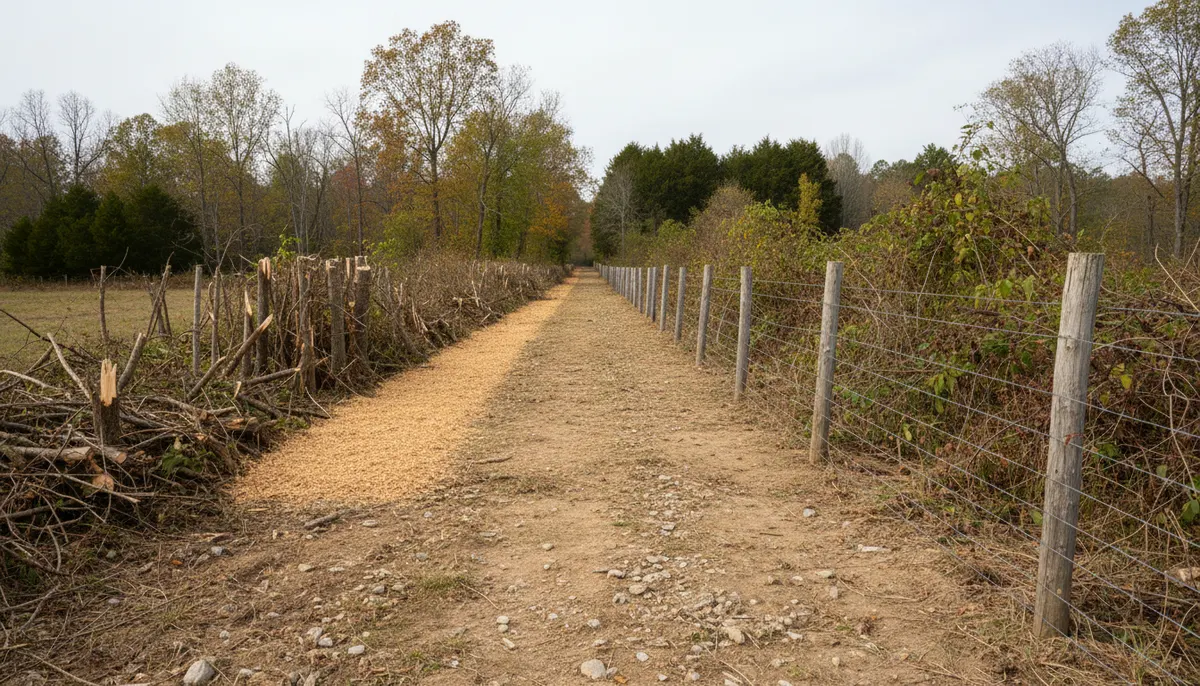
Fence line clearing in Clarksville, TN is corridor work, not acreage work. A strip along a boundary, a cross fence or a proposed line gets cut to a stated width so posts can be set, wire can be run and a tractor can get down it afterwards. In the way is usually honeysuckle and briar grown into old wire, plus volunteer cedar, locust and hackberry seeded along a line nobody has mown in a decade. Two things separate this from open-ground work: the job is bounded by a legal line rather than an area, and post holes count as excavation, which brings Tennessee 811 into a job most people file under fencing. Where the field behind the line also needs opening, that is a knockdown of the open ground, priced separately.
Three Fence Situations We Get Called For
A fence disappearing into a hedgerow
Wire still in the ground, growth closed over both sides. The strip is reopened so the fence can be walked and repaired.
A new line being run
Nothing built yet, so the width is set for the post driver rather than for the finished fence. That is wider than most people expect.
Cross fencing inside a farm
Interior divisions for rotational grazing, or splitting hay ground off a wooded corner. No boundary exposure, so the pass runs faster.
What Fits Down a Narrow Strip
Compact track loader with a mulching head
It turns inside its own length and spreads its weight on soft ground. Fecon publishes the guide we work to: 70 or more horsepower handles moderate brush and small trees, 100 or more suits heavy-duty work.
Excavator head for the reach
Heads are sold against carrier ranges from 3.5 to 10 ton machines up through 15 to 45 ton classes. Reach earns its keep here, because a stem comes out without tracks crossing the line.
Hand tools and wire recovery
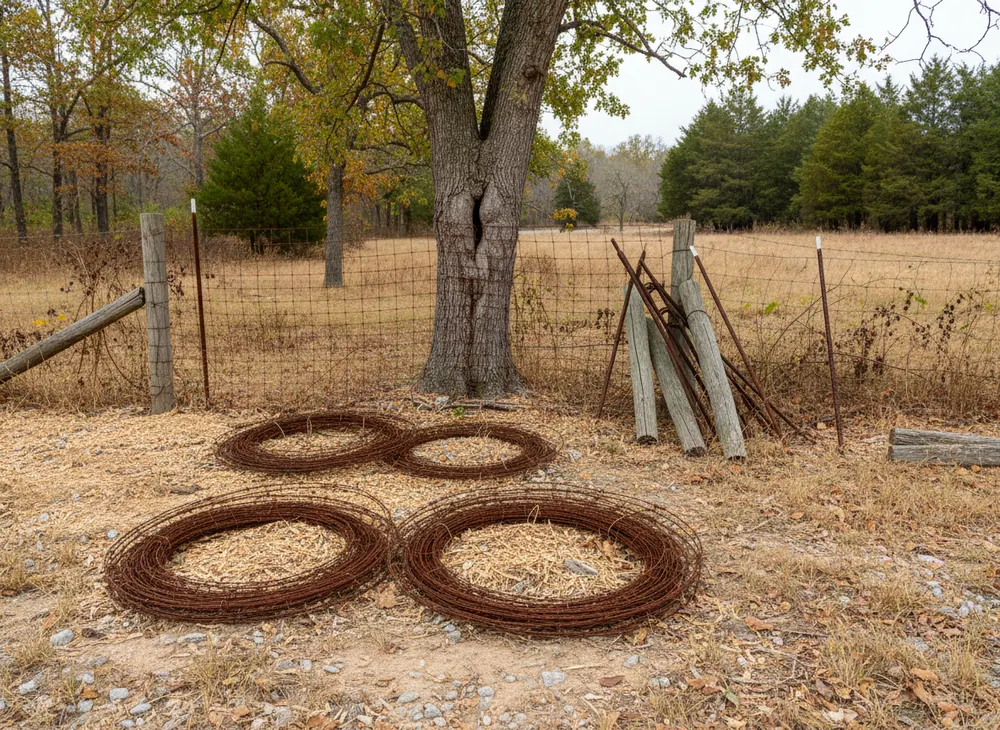
Barbed and woven wire comes out by hand first. Steel wrapped around a drum is the most expensive mistake on this job.
From First Call to a Cut Corridor
-
Establish the line
We walk it and look for pins, blazes or a fence both sides accept. Where the evidence disagrees with itself, we agree an offset on your side.
-
Fix the width in writing
Cut width goes on the quote as a number. It drives the hours and the price, and it is the term two bids differ on without saying so.
-
Place the 811 ticket
At least three working days of notice to Tennessee 811, marks good for 15 calendar days. Post holes are excavation and the notice covers them.
-
Pull wire, then cut
Wire and posts come out and get stacked or hauled. Only then does the head run, and material stays as mulch unless you want it gone.
The Two Things That Actually Go Wrong Here
Cutting on the wrong side of a line nobody has surveyed
A wire fence built sixty years ago sits where it was convenient, not where the deed runs, and hedgerows drift as the fence gets patched. Taking a neighbour's timber off the wrong side is not a scheduling problem, it is a liability, and nothing puts a hardwood back. Where pins are found and agree with the fence, we cut to the fence. Where they are not, we cut to a stated offset on your side and put that offset on the quote, so it is your decision rather than one made from the cab. Where a boundary follows a blue-line stream, the Tennessee construction stormwater permit calls for a 30-foot natural riparian buffer between the water and the disturbed area, preserved to the maximum extent practicable and never narrower than more than 15 feet at any point, so the corridor gets offset there. Corridors rarely reach the one-acre threshold that brings in the county grading, drainage and erosion control requirement, but the arithmetic is worth carrying: at a 15-foot cut width it takes roughly 2,900 feet of line to disturb a single acre.
Old wire, and what it does to a drum
Every neglected fence line in this county has wire in it and some of it is inside the trees. Woven wire stapled to a young hackberry forty years ago now runs through the trunk at chest height, invisible under honeysuckle. A drum that catches barbed wire wraps it and stalls, and the cheap version of that is half a day cutting the wrap off with the machine down. Hence the sequence: wire first, cutting second, and the strip walked rather than quoted from the road. Retired wire and posts are a haul-off item at the brush load rate of $150 to $200 for a full pickup load. Stumps are the other call. A fence line does not need clean ground the way a building pad does, so most stay, but a stump where a post has to go is ground at $2 to $6 per inch of diameter against an $80 to $160 minimum.
What a Fence Line Costs Around Clarksville
Converted from the Tennessee per-acre bands using your cut width, or priced by the machine day at $2,600 to $4,000
No published Tennessee survey prices this work by the linear foot, so we do not quote one. We convert the sourced per-acre bands using the agreed width, or price the day. No figure here is a quote.
| Scope | Typical range | What it covers |
|---|---|---|
| Light growth on a maintained line | $975 to $1,560 per acre of corridor | Grass, briar and scattered stems. Roughly 3 to 5 hours per acre. |
| Closed hedgerow with small trees | $1,430 to $2,210 per acre of corridor | The usual neglected boundary. 5 to 8 hours per acre. |
| Machine and operator by the day | $2,600 to $4,000 per day | Used where the line is short enough that acreage is a poor unit. |
What moves the price
- Cut width, which converts straight into acreage and therefore into hours.
- Density, the primary driver, worth a three to eight times spread on its own.
- Slope. Moderate grades add 20 to 30 percent, steep or rocky ground 40 to 60 percent.
- Stems over 6 inches in diameter, worth another 15 to 30 percent.
- Access. A line the trailer cannot reach adds roughly $500 to $1,500 in mobilisation.
Three thousand feet of boundary at a 15-foot width is a shade over one acre of corridor. In the hedgerow band that is roughly $1,430 to $2,210 of cutting, about a day on site plus the wire pull. The disturbance sits at the one-acre line, so it gets measured rather than assumed.
How We Keep a Boundary Job Straight
The offset is written down
Where the line is uncertain, the distance we hold off it appears on the quote as a number you approved.
Cut width is a quoted term
Not a range, and not left to the operator, because width is what one bid quietly trades against another.
Wire is its own task
Priced apart from cutting, so it never becomes an argument about what the machine hit.
Fence Line Questions Landowners Ask
How wide should the corridor be?
Wider than the fence, because of the machine that comes next. A post driver and a wire spinner need working room, and a strip cut to the width of the finished fence leaves the fencing crew pushing brush by hand.
Can you cut right up to the property line?
Only where the line is established on the ground. Pins, a recent plat or a fence both parties accept are evidence we can work to. Without that we hold an offset and say so in writing.
Does a fence really need an 811 locate?
Yes, because setting posts is excavation. Tennessee 811 requires at least three working days of notice under Tennessee Code 65-31-101, marks stand for 15 calendar days, and the tolerance zone is 24 inches each side of a marked facility plus the facility width. Boundaries are where services run, because that is where easements sit.
What happens to the brush and the old wire?
Brush is mulched in place, which leaves cover on the soil and removes the disposal line. Wire and posts get stacked and either left for scrap or hauled off at the load rate.
How do I keep it clear once it is cut?
A head cuts stems, not roots, so the corridor starts closing again from live root collars. The cheap answer is a rotary pass on a cycle while the sprouts are soft, at a fraction of what recutting a closed hedgerow costs.
Work That Usually Follows a Fence Line
Opening a longer access or utility corridor runs on the same logic but brings easement terms and a longer locate programme.
Keeping the strip open on a cycle is the maintenance answer once the first pass is done.
Removing the stumps sitting where posts go is priced by the inch of diameter, so it pays to batch them onto one visit.
Reclaiming the ground behind the fence is the larger scope where the field itself has gone to briar.
Book a Site Walk on Your Acreage
Send the parcel details and we will walk the ground, measure the disturbed area, check the stormwater threshold and put a written scope in front of you before any machine is booked.